
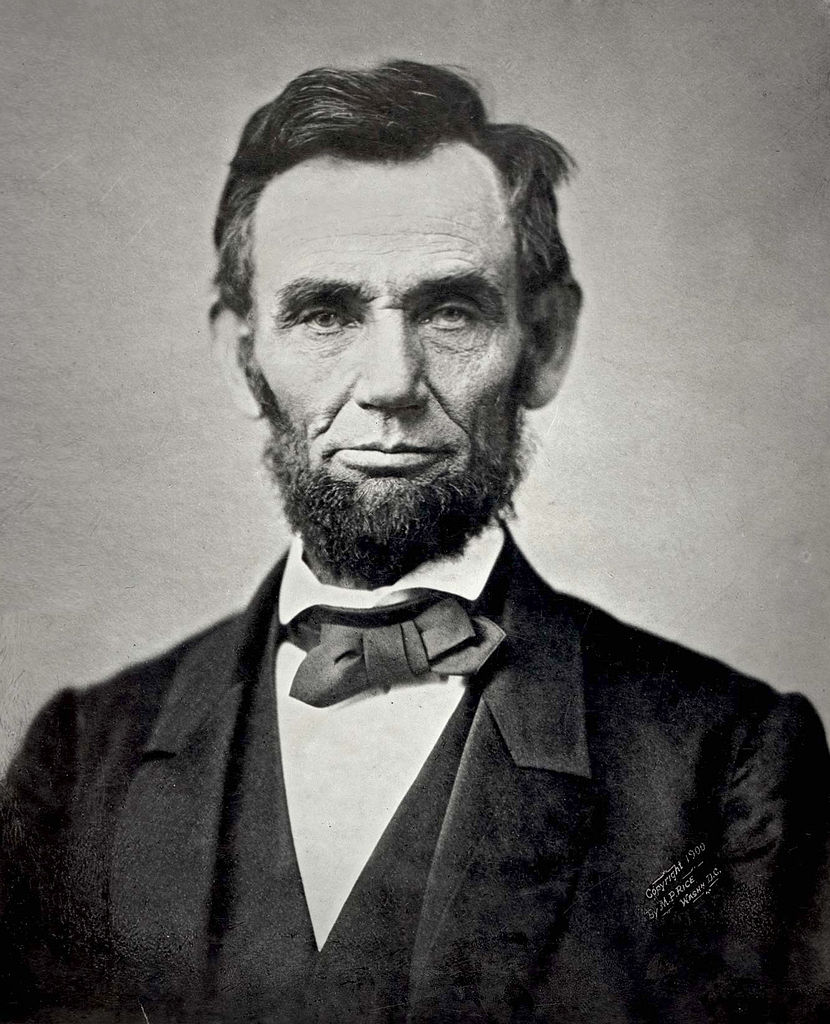
“Four score and seven years ago….” So starts one of the most recognizable speeches in American history. On the 19th of November 1863, 154 years ago today, Abraham Lincoln stood on a make-shift platform in Gettysburg’s Evergreen Cemetery, and spoke for a few moments.
David Wills, a resident of Gettysburg, would invite the President to, in a sense, sanctify the hallowed grounds, after the main speaker, Edward Everett, finished his oration. How does one ask the President of the United States to hop on a train, spend the night in town, wake up the next morning and sit through a 3-hour program, only then to take the stage for a couple of minutes? Yet, this was exactly what Lincoln did. To be clear, Wills intended for Lincoln’s speech to be brief for in his invitation to the President, Wills asked him to provide “a few appropriate remarks.” This was never going to be a State of the Union – length speech.
Well, the band played, the reverend prayed, and Mr. Everett, the main speaker of the day, talked for more than two hours. In writing this blog, I found his speech online, and read much of it (not quite the entire 13,607 words). It is quite good, but it did take me a few separate times to get through the reading. I can only hope that those in the crowd had a longer attention span than I do. Sadly, without reading the text of the speech, hardly anyone today would remember a single word of what he said.
Contrast that with what the President said. He stuck with what David Wills had asked of him, a few remarks. His “address” of just 272 words and 10 sentences took only about two minutes. However, unlike Everett’s speech, it lives on in the memory of, not only historians, but everyday citizens around the world. And herein lies the irony of it all; among Lincoln’s carefully selected words, he said, “The world will little note, nor long remember what we say here….” Well, Mr. President, you missed the mark on that one by a mile. The world does note and does remember what you said in those two minutes.
Also in his few appropriate remarks, Lincoln pointed out, that while he and others were there to dedicate this piece of sacred soil, in reality there was nothing they could do that was not already done. Let me highlight just two of the ten sentences he spoke that day; “But, in a larger sense, we cannot dedicate – we cannot consecrate – we cannot hallow – this ground. The brave men, living and dead, who struggled here, have consecrated it, far above our poor power to add or detract.” The devotion, the consecration, the sanctification, and finally, the dedication, had been done four and a half months earlier. Brave men had done what no one else, not even President Lincoln, could do.
Now bravery is one of those words that is talked about very little outside of certain circles. Way too many medals given posthumously have the word bravery in the citation. America has come to expect those in service to the nation to exude bravery. Police officers, firemen, and the military are all presumed to have bravery in their DNA. But what about those not in these occupations? Leaders today in all walks of life, in all career choices, no matter where they fall on the pay scale, have opportunities to show bravery every day. You see, bravery is not just running into a burning building, an active crime scene, or onto a battlefield. It is also standing up for what’s right. It is standing up for the little guy, the underdog. It is standing up for a purpose when no one else does. And the great thing about it is you can do it as an administrative assistant, as a server in a restaurant, as a stay-at-home mom or dad, as an auto mechanic, or any of the other thousands and thousands of careers that people get paid (or not paid) for.
The Bible gives account of more than one example of bravery displayed by those in less than warrior-like jobs. Consider Rahab. Though she was a prostitute (not a career choice I would recommend), she put everything on the line, literally and figuratively, as she lowered the spies down a rope. Consider David. Yeah, he became king if you’re impressed by that kind of thing. But before all that, he was a boy shepherd going against the Philistine giant. Consider Nehemiah. He was a but a cupbearer to the king. However, he led the reconstruction of Jerusalem in spite of numerous enemies who wanted nothing more than to stop the effort. If God can use a prostitute, a cup bearer, and a shepherd to promote bravery, how can He not use you in your chosen occupation. Be brave. The world will take note and will long remember you for it.
 Faith, Leadership, and History