Win v. Loss

I have played countless rounds of golf in tournaments and intramural sports while I was in the Air Force.  While I won quite a few matches in squadron competition, I never won a tournament either as a single player or with a team.  I’ve come close, but it was never in the cards for me.  If I would have stayed with the game anticipating an eventual victory, I would have been disappointed.  But I kept playing, not for the tournament wins, but for the love of the game.  And in that love for the game, I relearned a lesson from my childhood.

When I was 13 years old, I did something not very many people have done.  If you remember from a few weeks ago, I shared that I grew up playing baseball.  I was a good ball player.  I was selected to all-star teams every year I played (here is me trying not to boast).  When I was 13, I was again selected for a city all-star team, and we traveled around the metro area where I live.  On this particular day I was the starting pitcher.  The first few innings flew by as I was in a groove.  By the fifth inning I was still going strong.  It seemed with every inning I just gained momentum.  When the last out of the game was made, I had done something I never imagined doing…I had pitched a no-hitter.  I had walked three batters, so it would not go down in the books as a perfect game, but I was ecstatic anyway.

Now, if only every game I ever pitched went like that.  But it didn’t.  I’ve also been rocked by the opposing team’s bats, leaving the coach no choice but to take me out.  On those days, I didn’t feel so ecstatic.  The no-hitters are exciting and really cool to experience for sure.  But the times when the other team thrashes you is when character is built.  It is easy to celebrate the win and be thrust into the spotlight, but losing…not so much.

They call it losing with grace, but anyone who has lost a game in any sport will tell you that grace is one of the last things you feel…unless of course you are a saint…and a saint was, and is, the farthest thing from what I am.  But my dad was there – for the wins, and the losses.  Recently I heard a radio advertisement for high school sports and scholastics.  In it, a son had just finished a game and his dad was railing against him on all the things he did wrong.  Thankfully, my dad was not like that.  When I did have a bad game, my dad didn’t detail to me all of the things I did wrong.  In fact, he talked about the positive outcomes, choosing to put those less-than-optimal highlights in the trash can of memories.

Losing is just part of life.  No one wins every game.  Tiger Woods has won way less tournaments than he has entered.  The best hitters in baseball only get a hit about once every three at bats.  Babe Ruth had 2,873 hits.  Quite remarkable.  Babe Ruth also struck out 1,330 times.  Also quite remarkable…just not in the same way.  Nolan Ryan, who holds the stellar record for no-hitters (7), most strikeouts (5,714), and a whole host of other stats.  But he also had a career record of 324 wins and 292 losses…not that stellar.  Ryan also never received a Cy Young award, given to best pitchers in each league.  One of the greatest pitchers understood that losses come with wins…and in his case, a lot of losses.

What you do with those losses is what matters.  Of course the wins matter, and it’s those that will get you the ESPN highlights.  But it’s the losses that will define who you are, and as I said earlier, what will build your character.

I guess my dad understood that.  His way of helping me build resilience in those early years helped me immensely later in life.  During numerous military deployments I had that resilience tested on many occasions.  On my last one to Iraq, I had the honor of speaking to countless men and women from all branches of the military on how to build personal resilience through life’s experiences.  Many of those had lost all hope and felt there was nowhere to turn, in essence, they were thinking of taking their life.  Nothing shakes you to the core faster than someone sitting across from you and sharing those thoughts.  As I said, I was honored to have those conversations…and thankful that God used me as a vessel to be able to inject meaning and purpose back into their lives.  And it was that instilled resilience through life experiences that allowed me to stand in front of 850 basic trainees and talk about how important resilience would be for them in the coming weeks of training, and how important resilience would be for each of them throughout their lives.

One last thought to wrap this up…on the day of that no-hitter, the coach presented me the game ball with everyone’s signatures.  I still have that ball.  Occasionally, it gets pulled out of the drawer where it’s stored, and I get to remember that day again.  And in remembering that day of victory, I remember not all days are victories…and in remembering that, I remember how critical resilience is in our lives…and in remembering the importance of resilience, I remember it all started with a guy I called dad who showed me how to win AND lose graciously.  

It Rhymes with Attitude

You have heard the expression…a bad day at golf is better than a good day at work.  And it is absolutely true.  Not that work is necessarily bad, it’s just golf is so enjoyable.  That enjoyment is felt no stronger than when you hit a great shot.  I remember playing a round at Del Lago Golf Course in Vail, Arizona.  The #7 hole is a 172-yard par 3.  I hit a 5-wood off the tee box, and it was a beauty.  It flew straight at the hole, bounced a few times, and stopped two inches from the hole.  It remains the closest I have ever come to getting a hole-in-one.  I tapped it in, went to the next hole, a par four, and scored an eight.  In a matter of a few minutes, I experienced the complete opposite ends of the scoring spectrum…a birdie and a quadruple bogey.  Nothing changes though.  A bad day of golf is better than a good day at work.

Why is that?  Well, I guess it all boils down to gratitude, or thankfulness.  It really is hard to complain about being outside on a beautiful day, surrounded my nature, and playing a great game.  But even when you are not outside; even when you are stuck behind your desk at work; even though you might work in a cubicle along with hundreds of others; even when you have to work overtime…gratitude can still be yours.  That’s because gratitude is not an emotion to be experienced, it is a lifestyle to be lived.  

My parents have a little wooden carving hanging on their kitchen wall that says “attitude of gratitude”.  That resonates so much, but only if you let it.  I remember hearing a preacher once say that we should be thankful that we get to pay taxes.  Right now, you think I have totally lost my mind, or the preacher who said it lost his mind.  But think deeper about it.  If you are paying taxes, you have a job, or some kind of retirement income, and at the very least, you are still alive.  If you pay property taxes, you have a roof over your head and a car to drive.  

This again is one of those things I learned from watching my dad.  To be thankful for what life is offering.

Gratitude seems like such an easy concept to grasp, but alas, it eludes many of us.  There is always something more to gain, someplace different to go, someone else to beat out for that promotion.  We get so busy that we fail to recognize what we already have, the places we have already visited, and the co-workers we really don’t know.  In the midst of our individual chaos, let me suggest something George Washington wrote in honor of the Thanksgiving Proclamation of 1789:

“Whereas it is the duty of all Nations to acknowledge the providence of Almighty God, to obey his will, to be grateful for his benefits, and humbly to implore his protection and favor….”

Continuing,

“That we may then all unite in rendering unto him our sincere and humble thanks–for his kind care and protection of the People of this Country previous to their becoming a Nation–for the signal and manifold mercies, and the favorable interpositions of his Providence which we experienced in the course and conclusion of the late war–for the great degree of tranquility, union, and plenty, which we have since enjoyed–for the peaceable and rational manner, in which we have been enabled to establish constitutions of government for our safety and happiness, and particularly the national One now lately instituted–for the civil and religious liberty with which we are blessed; and the means we have of acquiring and diffusing useful knowledge; and in general for all the great and various favors which he hath been pleased to confer upon us.”

Dare I say Washington was on to something when he wrote of having a “great degree of tranquility, union, and plenty, which we have since enjoyed…”.   He had only been the president for six months but looking back at what this young nation had traversed through just a few years earlier, Washington recognized the importance of having gratitude in the moment.  When Washington sat down to write this proclamation, perhaps he had just read what the Apostle Paul had written to the church at Thessalonica, “Give thanks in all circumstances.”  If true, this would have resonated with him more than we can imagine.  From defeat to defeat, to that brutal winter at Valley Forge, to seeing close friends lose their lives on the battlefield, to being betrayed by a confidant and fellow general, Washington now says to be grateful.  That is a lesson I know I need…and probably one we all need to live better every day.

‘Merica

I love studying military history.  I have a master’s degree in it, so I guess it’s good that I do.  For many years now I have devoted a lot of time to studying the Civil War, but lately have returned to the 1700s and our nation’s initial fight for freedom.  How we came through the American Revolution the victors is a fascinating story and, honestly, quite mind-boggling on many levels.  Many of my past blogs have covered this timeframe and the people.  There is George Washington, the commander of the Continental Army.  There is also Alexander Hamilton, Nathaniel Greene, Patrick Henry, Paul Revere, Ethan Allen, and many more.  These men all served a fledgling nation at great cost to, not only their own lives, but the lives of their friends and families.

Consider the years since the formation of our country, and the elements are the same.  Most names are not as recognizable as George Washington, but the sacrifices are no less significant.  Elizabeth Jacobson, Daniel Carlson, Brittany Gordon, and hundreds of thousands of others…deployed to all regions of the world…Korea, Vietnam, Cambodia, Guadalcanal, Midway, Iraq, Afghanistan, Omaha Beach, Bastogne, Bosnia, and countless more.  Most of their names are known only by friends and family, yet each one of them represents something beyond measure and, quite frankly, beyond comprehension…they are part of a brotherhood/sisterhood that is like no other.

I remember playing my first round of golf after seeing the movie Bat 21, and thinking, there is no way a normal human being could do what Lieutenant Colonel Iceal Hambleton did in the aftermath of getting shot down behind North Vietnamese lines.  Evading the North Vietnamese for several days, a plan was eventually hatched whereby others he was in radio contact with would guide him to safety, in a rather unique way.  They would direct his movements as if he was walking his favorite golf courses.  For instance, the observer would tell Hambleton to walk the first hole at Tucson National.  Hambleton knew the details because he played there many times.  It was a 408-yard par 4 that ran southeast.  So, they wanted Hambleton to walk 408 yards southeast.  Then the observer would tell him the next hole to “play”.  The plan worked.  Rescuers eventually reached Hambleton and got him aboard an evacuation helicopter and back to U.S. forces.  Who knew that playing golf could save your life?

For the last 248 years, individuals have served in the military for various reasons.  And no matter that reason, they should be celebrated.  Today, less than one percent of the population of the United States serves in the military.  I talk to a lot of Veterans every week.  When I hear someone who served say, “I only served one term”, or “one enlistment”, I am quick to remind them that there is no “only” when it comes to service.  In other words, there is honor in any amount of service to our nation.  They served, and we should be thankful for that.  My dad taught me that.  He served in the Navy four years.  And because of that, he is a patriot of a special breed.  For as long as I can remember, my dad (who is 90 years old), has raised the American flag up the flagpole every morning, and has taken it down every evening.  This action is simply an outward expression of what is on the inside.  He loves, as is often joked about how George W. Bush said it, ‘Merica.  And because of that love, I see him as a patriot.

Let me close with a story of another patriot of long ago.  Nathan Hale was recruited by General Washington to become part of his spy ring.  Washington needed individuals to gather intelligence on British operations in New York City, and Hale volunteered.  In fact, he was the only one who volunteered.  So, into the city he went, under the guise of a teacher looking for work.  But it was not long before the British found out who he was and why he was there.  They captured him, and it did not look too good for the young patriot.  Death by hanging was the punishment for spying…and that is exactly what the British did to him.  In the minutes leading up to the hanging, Nathan was given a chance to speak.  We have all heard of the supposed words he uttered, “I only regret, that I have but one life to lose for my country.”  There is some disagreement about the exact words he used, but every written source of the day, has him saying words to the same effect, so there is really no doubt that he did indeed say that phrase, or something similar.  My personal favorite comes from a 1777 issue of the Essex Journal, in which Hale is reported as saying at the gallows, that the British were shedding the blood of an innocent person, and that if he had ten thousand lives, he would gladly lay them all down in defense of his country.

Patriots who have served our country come in all shapes and sizes.  They are a private citizen, turned general, turned president.  They are a Soldier, Sailor, Airman, Marine, who served in Iraq or Afghanistan.  They are a guy who “walked” a golf course to evade the enemy and find his way back to freedom.  They are a young spy who was caught and hanged for his crimes, and who would willingly give his life 10,000 times.  They are someone who served four years, and someone who served thirty years.  They are those who did not serve, but now serve Veterans in their greatest hour of need.  Yes indeed, patriots come in all shapes and sizes.

O beautiful for heroes proved; In liberating strife                                               Who more than self their country loved; And Mercy more than life! 

(3rd verse to “America the Beautiful”)

Don’t Use the Foot Wedge

The foundation of the game of golf is found in a single word.  It doesn’t matter if you are a 30 handicap, or the world’s #1.  It is so centric to the very ideals of the game on the professional level, that when a player thinks that he or she may have done something wrong, they call a penalty on themselves.  Now there are exceptions when a player tries to get away with something illegal, but it is a very rare occurrence.  There is not another sport that I know of where this happens.  Tom Brady never called a penalty on himself.  LeBron James has never admitted to a foul.  It would be unheard of if this occurred.  ESPN would run the story around the clock.  Yet, that is what happens in golf when a player breaks one of the rules.  It’s all because of one word.  Integrity.

There were many times when my integrity was tested during a round of golf.  After all, I am just a weekend hacker, so what is the harm in fudging a little?  Maybe move that ball out of the bunker.  Maybe tap the ball a couple of inches into the fairway and out of the thick rough.  You often see casual golfers use the “foot” wedge…that is, they kick the ball into a better position.  My philosophy was always that I got myself into the position I was in, so the challenge was to get out of it in the best possible way.  Having your golf ball end up in bad positions is part of the game, and you cannot move it in competition, so why move it when you are just playing casually?

So where did I learn integrity?  If you’ve been following my blogs recently you are going to know the answer.  I could just wait here and have you go back and read those latest entries, but I will go ahead and tell you (but seriously go back and read the past stories).  My dad taught me integrity.  Now, he didn’t sit me down and tell me, “Son, you are going to be tested in life, and integrity is going to help you in every one of those instances.”  It did not happen like that.  Instead, he showed me.  He showed through what he did and what he said.  Integrity is not easy, and more times than not, it is the hardest thing, the most difficult choice.  But when faced with those kinds of options, don’t you want to choose the one that is going to give the best outcome?  Of course you do.

Before we go any further, I guess it would help to understand where I am coming from so that we are on the same page.  Integrity simply means being honest and holding strong moral principles.  I have always liked this picture of integrity…doing the right thing even when no one is watching.  It is easy to do the right thing when all eyes are on you.  But the second those eyes turn away, the pressure is really on.  Back in the golf world, it looks like this.  Your golf ball is in some really thick rough, and your competition is standing right there next to you.  Obviously, you are not going to move your ball.  But what if that person you are playing against is nowhere in sight, are you going to move your ball?  Integrity says no, even when it would be easy to do so.  In life it is no different.  When faced with a decision that will test your character, will your response be different if someone is standing right next to you?  Integrity reminds us that doing the right thing is not dependent on whether someone else’s eyes are upon you.

Integrity is one of those things where I cannot point to a specific instance when my dad revealed how important integrity was or how “integral” it would come to be in my life.  But I can say this, when the Air Force (my employer for 30+ years) created its current iteration of core values in 1995, I was already well versed in integrity.  “Integrity First”, “Service Before Self”, and “Excellence In All We Do” are the three core values the Air Force is built on.  Integrity is first because everything else hinges on it.  Work ethic, morals, values-based decision making, how you will treat others, all start with integrity.  If you think of it in terms of a house, integrity is the foundation, the very thing that the rest of the house is built on.  Poor foundation, and the house will fall.  Strong foundation, and the house will last generations.

When I think of integrity in the light of history, many examples come to mind…both good and bad.  George Washington stepped down after two terms as president not because people wanted him to, or because his terms were riddled with scandal.  Instead, he left because he felt that his time in office would become a precedent, that is, others would emulate him, and he did not want the presidency to become a lifelong appointment, ultimately fearing that a president would hold too much power for too long, much like a king. That precedence stood until Franklin D. Roosevelt ignored Washington’s warnings and ran for a third and fourth term.  In 1951, the 22nd Amendment became law, limiting an individual to two terms as president.  Washington’s example bleeds integrity.

Then you have another guy who served under Washington, and who Washington himself, called the fighting general.  Benedict Arnold.  Sides have debated for years as to whether he deserves all the bad press he receives.  However, what is not up for debate is the fact that he was an outstanding general for the patriot cause, winning major battles for Washington’s army.  But when he was injured and then passed over for promotion, he felt disrespected and turned to the other side, hoping to hand over West Point and the Hudson Valley region to British control.  What is the cause for when an outstanding general like Arnold, though rightfully angry about how he was treated by some in Congress, tries to influence the fall of his own country.  Something was not right at the very core of his character.  Dare I say he lacked integrity?  If we return to that basic idea that integrity is doing what is right even when no one is looking, then we have a clear case of a lack of integrity in Arnold, for when no one from the American army is looking, he is trying to betray them.  So, two early American figures, both challenged with doing what was right, but only one comes out the other side successfully.

Let me close this up by going back to my dad.  He is an amazing dude.  He is not perfect.  He makes mistakes.  But I’ve never witnessed a lack of integrity in his character.  When the right thing needs to be done, my dad does it.  And in doing so, he has helped shape the responses to challenges in my own life.  So, the next time you are tempted to move that ball to a better position, or go down the path that challenges your character, take it from my dad, and do the right thing.  You won’t be disappointed.

Strengths are Hereditary…Except When They’re Not

Throughout my years of playing golf, I have played in a lot of tournaments.  There have been all kinds.  There is the two-man alternate shot, where each player takes turns hitting the ball until you finish the hole, and then you continue in this manner for the rest of the round.  There is the four-man scramble, where every player tees off, then the team chooses the best shot each time.  There is the more challenging tournament where every player hits his own ball every shot, and once the hole is over, the best score of the players on each hole is recorded on the scorecard.  I even remember playing in a tournament where each player could pick up their ball and throw it to extend that shot.  We were playing the Raptor Course on Langley Air Force Base, and it was on the 306-yard, par 4, 15th hole.  I had my usual drive of about 250 yards, so I had a little over 50 yards to the green.  I thought for sure I could sling a golf ball close enough to where it would roll onto the green.  I learned in that moment that throwing a golf ball is not that easy.  You can probably guess my throw didn’t go anywhere near the distance I expected.  

Now, ideally in any tournament, you have a team that consists of all great players.  But for most of those I played in, we just wanted to have fun.  But we did try to gather players with different strengths.  For example, we wanted someone who could hit the ball a mile off the tee.  We also wanted someone who could putt really well.  That way each player felt he or she contributed to the effort.  The way to the best score was to utilize everyone’s strengths.  Much like my dad taught me.  Use the strengths you have, do your part, and do your best.

You’ve probably seen this saying, or one like it, before: “Growing up every boy thinks his dad knows and is great at everything.  When that boy becomes a teenager, he thinks his dad knows nothing and can’t do anything right.  When that boy becomes an older adult, he remembers his dad did know everything, and was great at everything.”  I can identify with the child, though as a teenager, I never fell into the trap of thinking my dad was a clueless parent, and as an older adult, I understand that my dad never really knew everything, but that doesn’t erase the fact that he knew stuff about a lot of things.  I’ve written about this before, but my dad was exceedingly mechanically inclined.  That was one of his significant strengths, and something that he could do better than any other person I knew.  He took that strength and did his best with it.  He just had an uncanny ability to fix anything he got his hands on.  And when he lacked things to work on, he helped others and I never remember him asking for anything in return.  He could visualize something and then bring that vision to reality.  In short, my dad found what he was good at.

Samuel Adams is the face of a major beer brand today.  (That came out of left field, didn’t it?  I promise it will make sense in a moment.)  Did you know that it is widely believed that he had nothing to do with brewing beer, and instead worked in his family’s malthouse?  Now, it is true that malt is necessary for brewing beer, but according to historians, Sam did not make beer.  Not only did Sam not make beer, he also didn’t make money.  He had a miserable business mind.  He was so bad that he bankrupted the malt business owed by his father.  But that wasn’t even his first business failure.  When a younger Sam received a significant amount of money from his father for another business venture, that failed as well.  Sam just was not good with the money and the business aspect of, well…running a business.  But what Sam lacked in business, he more than made up in his ability to communicate with clarity and to organize the patriot cause that stirred Americans to rebel against the British crown.  He is called a founding father for a good reason.  He served on both the First and Second Continental Congress, and according to many, was the heartbeat of the revolution.  He wrote under several aliases as he sought to inspire his fellow Massachusettsans in the fight for their rights.  He very likely was the impetus behind the patriots boarding three ships in the Boston harbor and dumping tea into the water in what we know today as the Boston Tea Party.  With the value of the tea at 9,700 British Pounds (approaching $2 million in today’s money), it is no wonder the king responded by applying greater pressure on the colonists.  But Sam and others would not be persuaded to relent.

I bring Adams’ story up because he was someone who, despite failure in what should have been a no brainer for him…making malt for beer, found that his strengths resided in a completely different venue.  That is how it is sometimes.  I am much like Sam in this way.  He should have been a shoe in for running the family business…except he wasn’t.  I should be an excellent fixer of all things mechanical…except I am not.  And that is perfectly fine.  That is what my dad taught me…to find my strengths and use them in the best way possible.

Throwing a golf ball will never be my strength, nor will fixing machines.  But I learned a few years ago, after taking the Strength Finders Assessment, that my strengths are kind of nerdy (if I may use that word).  After the assessment, my top six themes were Analytical (data driven, want to understand patterns and how they affect outcomes), Achiever (need to experience attainment or accomplishment), Deliberative (like to plan ahead so you can anticipate what might go wrong; you are a private person who selects friends cautiously), Context (you look back in history to understand the present), Developer (you see the potential in others and want to help them find success), and Intellection (solving problems and developing ideas, and other mental activities that are important).  When I look at that list, I realize that those are indeed some of my strengths.  They served me well over the years as a leader in the Air Force, and ultimately in my time working in the Pentagon.  And I owe it all to my dad, who showed me the value of finding my strengths, putting them to good use, and always striving to do my best.

My Dad’s Hands Tell a Wonderful Story

I had hit my tee shot right down the fairway of the first hole at Incirlik Air Base’s golf course, “Hodja Lakes”.  I was 124 yards from the green, so I grabbed my pitching wedge, took a couple of practice swings, lined up the shot, and hit the ball.  It flew on a perfect trajectory going right at the flagstick, and to my utter shock, bounced once on the green, and disappeared into the hole.  A score of 2 on a par 4…an eagle.  I was playing alone, so there were no celebratory high fives with anyone (bummer), and then the thought occurred to me – would anyone believe me?  But as I walked up to the green, one of the course maintenance workers came riding up in his cart and congratulated me on the shot.  Someone had seen it after all (yay me)!

That shot came as a result of a lot of practice shots on the range, lots of rounds of golf, and following basic fundamentals of golf.  And there might have been a little bit of luck thrown in.  Now, I am going to write something that is profound…so profound it will blow your mind.  Probably not, but here goes.  Your hands are important in the game of golf.  Yeah, I know what you are thinking.  Thanks Captain Obvious, I would have never thought that had you not told me.  Before too many forehead smacks, let me explain.  In golf, the grip of the club is important.  I won’t go into too many details, but there is such a thing as a strong grip, weak grip, and a neutral grip, and it has nothing to do with how tightly you are holding the club (more on that later).  Instead, it all centers around how you place your hands on the club.  Strong grips can lead to more distance, but weak grips generally give more accuracy.  The determiner is found by holding the club as if you were going to hit the ball, then look to see how many knuckles you can see on your hands.  Now, back to how hard you grip the club.  That too is important.  You don’t want to be choking the life out of your driver when you are about to crush one down the middle of the fairway.  The converse is true as well…you don’t want to hold it so loosely that it flies out of your hands on your downswing and into the lake next to you.  The sweet spot is in the middle.  Ok, enough about the game of golf and one’s hands.  Onto the lesson I learned from my dad.

What you do with your hands in life is infinitely more important than learning to hold a golf club correctly.  My dad was always creating things with his hands.  I don’t know if he ever read Ecclesiastes 10:18, “through idleness of hands the house leaks”, but I do know that no house we ever lived in was going to leak, because he had the farthest thing from idle hands.  Maybe your dad was like that too so you can appreciate what I am saying.  One of the fascinating thing about hands is that they will tell you a lot under close examination.  A surgeon’s hands require delicate work, so they are in pristine condition.  A mechanic’s hands are often greasy, dirty, with chipped nails.  A farmer’s hands are calloused and sunbaked.  A construction worker’s hands are usually scratched, bruised, and blistered.  And an artist’s hands might be covered with clay, paint, or chalk, depending on their chosen medium.  In other words, hands tell a story of who someone is.  My dad’s hands were a combination of all these…well, maybe not the surgeon’s hands, but definitely the rest.  That’s because he was a combination of all those kinds of people.  If you remember from a couple of weeks ago, I wrote about all the cars and motorcycles he worked on, so his hands were greasy a lot.  (Just now, I remember my dad had this kind of hand cleaner in a silver can that was the consistency of watered down Crisco shortening.  It had an interesting smell, but it sure could clean your hands of all grease and oil).  My dad grew up on a farm, so he well understood farmer hands, and he was masterful when it came to creating things out of wood, so he often had stain, paint, or sealant on his hands.  And when it came to construction type of work, my dad never shied away from big projects.  He put new siding on the house; re-shingled the roof; remodeled the kitchen; framed, tiled, and built a second bathroom in the basement; and even built a deck on the back of the house.  And when winter came, he would be out there with the snowblower and shovel, going down the street clearing driveways and sidewalks of numerous neighbors.  So, you see he never let idle hands be a thing.

My dad worked as a machinist on an assembly line for 37 years.  His hands were always either fixing things on those lines or changing parts out to accommodate different products.  The company he worked for made cans for many food production companies, and chances are you ate or drank something out of a container or can that was made on his line.  And a few years before he landed that job, my dad served in the Navy where he was an aircraft mechanic.  Again, busy hands fixing things.  My dad is 90 now, and he moves slower, but he still finds ways to keep those hands active.  He and my mom find time to help feed the homeless at local shelters, along with many other service projects they do with their church.  In recent years, they’ve been bell ringers for the Salvation Army.  I’m pretty sure that those hands will stay busy for as long as he walks on this earth.  

I like to think that one of the lessons I learned from him was to avoid idle hands, keeping busy doing productive things…not just doing things for the sake of doing things but accomplishing meaningful work with the hands I’ve been given.  Like my dad, I hope to be finding things for my hands to build and fix, and projects that serve and help others, for decades to come.  And who knows how many more magical golf shots I have left in these two hands.

Be There

Last time we stood on the tee of a 610-yard monster in Arizona.  This time I look back to when I stood on the tee box of a 177-yard par 3…much shorter, but a monster as well.  This hole, called Braes, is #17 on the Castle Course at St. Andrews.  St. Andrews, if you don’t know, is the Holy Grail of golf, and is composed of seven different courses.  The Old Course is where the Open Championship, one of golf’s majors, has been played numerous times.  It has been in existence since the 15th century.  Along with this gem, is the New Course, which has ONLY been around for 128 years.  I’ve played these courses, or at least portions of them, along with the Jubilee, and the Castle Course, which is the newest addition to St. Andrews, opening in 2008.

The 17th hole on the Castle Course is, like I said, a par 3.  But it is not like most par 3’s, where you don’t need to worry if you are short of the green.  On this par 3, you have to make sure you carry the entire distance from the tee box to the green.  Why?  Because if you are short, your ball will end up either in the unplayable gorge between the tee and green, or in the North Sea.  When you are standing on that tee box, you must calculate the strong wind blowing in from the right and adjust your shot trajectory accordingly.  Being a left-handed golfer who hits a mild fade, it meant that I aimed right and hoped that the wind carried the ball back to the green.  I did just that.  I hit the shot…and it was a beauty…right over the North Sea and rocky coastline, and the wind obliged.  My ball worked back to the left, aided by the wind, and landed on the green.  I’m not going to lie, I walked up to the green feeling pretty good.  I left my birdie putt a few inches short, and settled for a par.  Now, there were a lot of things to get distracted by…the tee shot over the crashing waves of the North Sea, the howling wind, reliving shots, both fantastic and fantastically bad, from the previous 16 holes, and certainly not least…the realization that you about to finish a round of golf at freaking St. Andrews.  They all sought refuge in my thoughts.  But to pull off the shot, I had to stay in the moment.  There was no room for my thoughts to be anywhere else.  I had to be present because that is what mattered. 

Growing up I played baseball.  A lot of baseball, and I was pretty good.  College good, but not good enough to turn pro.  I played first base, from my first practice when I was 7, until I quit baseball my senior year in high school.  (I quit because of a personality conflict with the coach.).  I also pitched, and I wasn’t bad at the either.  I even pitched a no-hitter, and if not for a couple of walks, it would have been a perfect game.  I was also a decent hitter.  The summer going into my junior year, I held the highest batting average in the summer city league, a nice .485.  But playing first base was what I loved.  It seems rather obvious to say this, but to be good at the game of baseball, or anything for that matter, doesn’t come without a tribe of individuals who make you better.  I had a lot of great coaches throughout the years of playing.  They all had a hand in how well I played.  I had several good teammates as well.  They made me better too.  Then there was my dad.  He was there every day, in the backyard, honing my catching and fielding skills.  He would throw balls as far into the air as he could.  He would throw ground balls onto our uneven backyard for me to field.  That would serve me well later when a bad hop occurred.  He would give me a target to practice my pitching.  During every one of these practice sessions, the most important thing was that he was there.  He was present and that is what mattered.

I don’t remember my dad ever missing a game…and there were countless games.  In addition to the teams I played on, I made all-star teams for tournament play at the end of the regular season.  Sure, he might have gotten there late because of work, but he arrived to see me play in every one of those games.  To this day, my wife (obviously my girlfriend at the time) tells the story of my dad getting to the game after the start, climbing into the bleachers, and asking her how I was doing.  If I was pitching, how many strikeouts did I have, how many runs had I give up, etc.  If I was playing first base, how many balls did I field, and how was my hitting.  She learned after that first time to write down all of those vital statistics.  You see, even though he might have missed an inning or two, he showed up.  He was present.  And that is what mattered.

Now I want to tread lightly here, because I know not everyone has or had a dad like mine.  Heck, some boys didn’t have a father figure in the home at all.  I believe with all my heart, that every boy needs this.  That is not to say that a mother isn’t critically important, because she is.  But a father-son relationship is like no other.  Too many kids end up in a place that is devastatingly bad.  And too many of those lack a father in the home.  This is not just empty words.  It is factual.  Statistics prove it.  I’ve seen it…from mentoring teenage boys in juvenile detention to mentoring students through Teammates, a program started by former Nebraska Football coach Tom Osbourne.  He saw the same effect of fatherless households and took action.  Boys need men in their lives.  If not a father, then a mentor…if not a mentor, then a coach…if not a coach, then a teacher…if not a teacher, then a big brother.  Someone has to step up and be present.  Because it matters.

Back to my dad.  He taught me a lot, just by being around.  By him being present, I learned how to fish, how to drive, fix things around the house, woodworking, change the oil in my car (though who does that anymore?), and the value of hard work.  These barely scratch the surface of what I absorbed through his life instructions, but you get the idea.  He was present, and I am a better person because of it.  Let me return to that par 3 at St. Andrews.  Remember how I mentioned all the possible distractions fighting for my attention, trying to pull my mind from the objective?  Yeah, that happens in real life too.  All of those times my dad was trying to teach me something valuable, there were other things at war for my attention.  And I can say honestly, and regrettably, that sometimes those other things won.  I missed out.  And as I think back, I realize that I was the one not present in those situations.  Fortunately, I have a dad who was patient and gave me many more opportunities.  For that, I am eternally grateful.  Let me close with a couple of quotes from people you may or may not be familiar with.  They realized, as my dad well understood, the importance of a father being present in a son’s life.

“It is easier to build strong children than to repair broken men.” –Frederick Douglass

“My father used to play with my brother and me in the yard. Mother would come out and say, ‘You’re tearing up the grass.’ ‘We’re not raising grass,’ Dad would reply. ‘We’re raising boys.’” –Harmon Killebrew

The Fortieth Time was the Charm

I stood on the tee box of the longest hole I have ever played.  I was with Dan, a guy that I originally met when I was stationed in Turkey.  We were now both assigned to Davis-Monthan Air Force Base in Tucson, Arizona.  Dan had invited me to play this course with him, and since it was a place where the PGA professionals played, I could not pass the opportunity up.  So here we were, at Tucson National Golf Course, about three quarters of the way through our round, and we came to hole 15.  Now, for some reason that day, we decided to play from the farthest tee markers.  For most of the holes, that meant about 20-30 yards further back from the regular men’s tees.  But then, like I said, we came to hole 15.  It is a beast of a hole at 610 yards…70 yards longer than the regular tee.  The scorecard describes the 15th hole in this way; “No holding back off this tee as you’ll need everything you’ve got to reach this green in three shots.”  You think?  This is probably a good place to let you know that even though I carried an 8 handicap, I was never a long hitter.  My typical drive at this time was about 240 yards.  (A person’s handicap means that they should take that many shots higher than par to finish the round.  For example, my handicap was 8, so on a par 72 course, I should be able to shoot an 80 for my final score).  On this particular hole, I don’t remember how far I hit my drive.  That isn’t really important.  I’m sure it was somewhere in the 230-240 yard range.  If you do the math, I still had about a mile to go to get to the green.  Most golfers don’t hit their driver from the fairway, so out came the 3-wood.  I hit that about 190-200 yards.  Again, do the math and you see that I still had nearly 200 yards to the green.  I probably hit that 3-wood again.  When I walked off that green, I scored a bogey, which was pretty good considering what I thought I would probably take when I first laid eyes on that 610 yard monster.

When you come to a golf hole like that, it will test your perseverance, your stick-to-it-ness.  If you are having a horrible round, you might wonder if you will ever get to the green.  If you are shanking the ball left and right, you might be tempted to just pick up your ball and move to the next hole.  But if you are committed to persevering, you might just get a good score.  And you will undoubtedly learn a valuable lesson. 

If you had a dad like mine, you got this lesson early, and you got it a lot.  As I was growing up, my dad built, rebuilt, or restored a lot of vehicles.  It seemed like he was always tinkering with something.  I don’t know the exact number, but I can remember many of them.  (Though I admit I there a couple of them that I was unaware of, mostly because I wasn’t yet born.)  There was a 1964 Ford Galaxy convertible, a 1964 Lincoln Continental, several Honda motorcycles, and even a 1974 Harley Davidson Electra Glide motorcycle.  There was a camper he built from scratch that he then mounted on his pick-up truck.  There was an old boat that he bought and turned into a pretty decent bass boat.  There was my grandad’s tractor that he repaired and restored.  And then there was what I consider the crowning achievement, a 1931 Ford Model A pick-up truck.  What he brought home would eventually become a masterpiece, but on that day, it was only a beat-up, hail-dented, rust bucket of a cab (no frame, no engine, no truck bed, no nothing except that cab) that had sat in a farmer’s field for years.  When he pulled in the driveway with it on the back of a trailer, my mom questioned what the heck my dad was going to do with it.  But more than a year and a half later, it was a beauty.  

I can say unequivocally that there is no way I would have kept some of these projects alive.  They would have ended up in the trash heap of failure.  If you saw the condition of some of them, you might imagine the same future.  One more thing about that 1931 Ford.  He won numerous car show awards with it.  A LOT of people talked about it.  Then, years later he sold the truck to an individual who continued taking it to car shows.  This guy went around telling people that he built it.  I’m sure there were many people who knew what he was saying wasn’t true, but that did not stop him.  When my dad learned of what the guy was saying, he searched for him at the next show, and in front of a lot of people, called him out.  Ok, no, my dad didn’t do that.  In fact, he never said a word about it to anyone, even though he was the one who poured the sweat equity into the truck.  But that’s who my dad is, and that’s a lesson for another blog.  

Many people today cannot fathom working on something for a great length of time…certainly not something for more than a year.  And 18 months?  Impossible.  But not my dad.  He had perseverance to keep after something.  Thinking back, watching him day after day work on these cars and trucks and motorcycles (oh my), I now realize it takes perseverance to learn perseverance.  That perseverance I learned came in handy, when just about 7 years ago, I set a goal of running 1,000 miles in a year. When I set out on that first day, I simply didn’t realize what I had gotten myself into. Let me explain. If you run everyday, you need to run about 2 3/4 miles each of those days. If you are not feeling it on a particular day, then it means you run 5 1/2 the next. If there is an extended period of sickness or soreness, then it’s…well, you get the picture. At the time, I was assigned to the Pentagon and I traveled a lot. Most travel days were a no-go for running because of the schedule of events. What I am saying is, there were many opportunities for me to throw in the towel and just accept the inevitable. But I found myself slowly making up those missed days. I know I fell behind multiple times, but I would just bear down and get back to the goal of the moment. Then it came down to the last couple of weeks. I was behind quite a bit. But you don’t chase after a goal for 350 days only to quit at the eleventh hour. I remember that it came down to the very last day, and I was 9 1/2 miles behind. I was not home on this day, and I didn’t have my GPS watch. For the life of me, I cannot remember why…I just didn’t. But there was a high school running track. You might realize where I am going with this. A school track is 1/4 mile long, so 4 laps make a mile. Remember I had to run 9 1/2 miles. Yep, that meant 38 laps. If there was any excuse to quit, it was that I had to run 38 times around the same track. But I did it. I persevered. And when I was finished I vowed to never run on a track again.

Now, when you think of the word perseverance, maybe your dad isn’t the first person that comes to mind.  That’s ok.  Here are a few others that are worthy of mention.  Henry Ford is one of the greatest individuals in the history of the automobile.  But did you know he failed multiple times in his efforts trying to start an automotive company?  Milton Hershey is world famous.  I bet you’ve had some of the candy that bears his namesake.  Did you know he dropped out of school after the fourth grade?  Like Ford, he tried several times to build a company, but success eluded him.  He would eventually find that success in creating a company making caramel in Pennsylvania.  He later sold that business and formed the Hershey Chocolate Company.  Ever wonder where the name of the universal lubricant WD-40 came from?  I’ll give you a hint.  There were 39 failures before success was realized.  All of these prove just how important having perseverance is.  Can you imagine if Ford, Hershey, and Norman Larsen (the guy who invented WD-40) gave up and didn’t keep trying?  We would not be able to drive our  F-150 truck while eating a Hershey candy bar on our way home after helping a friend loosen a rusted bolt with a can of, not WD-14, WD-23 or WD-39, but WD-40.  That is what perseverance looks like.  

Here’s one more thing that perseverance looks like…a dad teaching his son that when life’s challenges show up to knock you off your feet, you must stay resilient and push on.  So, when you barely have a passing grade in that class you are ready to give up on…perseverance.  When that 9 to 5 job is getting the best of you…perseverance.  When you have tried 39 times to get something right but have fallen short…perseverance.  And when you are standing on the tee box of a 610 yard monster par 5…perseverance.

Preparation Isn’t Just a Word on a Box of Creme

As I write this, my dad is in the hospital for the fifth or sixth time this year…to say that it has been a rough year for him would be an epic understatement.  I am just thankful that he has my mom and sister there to help take care of him.  Each “stay” in the hospital is more difficult than the last.  He’s 91 so the recovery time isn’t the same as someone half his age.  In fact, we have a running joke.  When he feels like he just can’t do the things he did decades ago, I jokingly remind him of his age by saying “#91”.  This has been going on for better than five years.  I know this because in the beginning it was #86, and when he turned 88, it was #double ocho (ocho being the Spanish word for 8).  So, this past year I’ve been thinking a lot about my dad and the things he handed down to me.  

I have his old band saw sitting in my wood shop.  I brought that back from one of my visits this year. Another time he showed up and gave me a dozen or so screwdrivers.  For the record, I already had at least a dozen, but who doesn’t need more screwdrivers?  He has given me some of his wood clamps, a router table, table saw blades, craft magazines, and project plans.  I’ve used all of them.  But I am not referring to those things.  The things I am writing about are not physical items.  What I have been thinking about lately is infinitely more important than a Phillips head screwdriver or carbide-tipped saw blade.

Because of that, for the next several weeks I am going to put down on paper (or rather blog page) those things I learned from my dad.  Some things he intentionally taught me…others I learned from watching him, even when he didn’t know it.  I want to do this in a rather unique way.  I want to equate these incredibly important life lessons to playing a round of golf, with each hole being a different life lesson I’ve learned from the greatest man I know.  

Before we step up to that first tee and address the ball (if you are not familiar with the game of golf, addressing the ball means lining up the shot and mentally preparing to hit it), I want you to realize every golfer falls into one of three categories.  The first category includes those that show up to the course an hour or two before their tee time.  Some golfers head to the practice putting green, some make their way to the driving range, and others grab their wedges and go to the chipping area.  Those that are serious about their game do all three.  Those are the smart ones.  The second category includes those that show up with a comfortable amount of time to spare.  They might mess around on the putting green for five or ten minutes, get a snack, and then head to the #1 tee.  Then there are those who you can see from a distance, traveling at light speed to get to the parking lot, where they barely have the car in park before they are jumping out, running around to the trunk, grabbing their clubs, racing to the #1 tee box while simultaneously trying to change into their golf shoes, and finally arriving out of breath, all while their playing partners are standing there shaking their heads in utter disbelief at what they just witnessed.  They tee up the ball, take one practice swing, and then channeling their inner Tiger Woods, proceed to hit the ball.  As much as they want that ball to sail down the middle of the fairway, it doesn’t.  Instead, it balloons off into the woods on the left.  I can neither confirm nor deny that I know this from experience.  However, like I said, the smart ones take the time to prepare themselves, practice some shots they know they will have on the course.

My dad wanted me to have all the “tools” and the knowledge of how and when to use them.  He could have just told me good luck on trying to figure life out.  Too many fathers do just that.  But he didn’t.  Unknowingly at the time, he did what Proverbs 22:6 instructed him to do, “Train up a child in the way he should go, and when he is old he will not depart from it.”  

You want to know how important it is to have good instruction from fathers?  You want to know how critical the instruction is that will impact lives in a positive way for their children, and their children’s children?  Look with me at 1 and 2 Kings in the Old Testament.  Beginning in 1 Kings 12, we start the journey of a long narrative of rulers over Israel.  When a king dies, usually the first-born son assumes the leadership mantel.  And it goes something like this, “Now Nadab (or insert any one of the 30 kings like him) became king over Israel in the second year of Asa king of Judah, and he reigned two years.  And he did evil in the sight of the Lord, and walked in the way of his father.”  Now when it says that he walked in the way of his father, it does not mean that the son had a gimp leg like his dad.  No, it means he continued to commit the same atrocities he learned from a son’s greatest teacher…his father.  And it didn’t stop with one generation.  It kept going.  It was cyclical.  Someone new came along, killed the king, and took his place…and did evil.  On and on it went.  Thirty times to be exact.  It became so bad, that there were times when someone out of left field entered the story, killed off the king and took his place.  Of course, there was always someone over the horizon waiting for their coup moment.  That’s when you know there exists a failed culture.  But just when you’ve about lost all faith, a good king arrives.  He does good things, restores hope, and rules justly.  In the narrative of the kings, this only truly happens four times (there are another five kings who did some things justly, but not to the level of the four righteous kings).  

So, now that you understand how imperative it is that a father’s message to his children is done to prepare them for success in life, we are ready to start our round.  See you in a few days.  Next stop…#1 tee box.  

Bayonets and Bogs

I first met him while taking a class for my undergraduate degree.  To say I was fascinated with him would be an understatement of epic proportion.  I was, simply speaking, captured by the many facets of his life.  I could not get my fill of information about him, even to the point that I wrote my undergraduate capstone paper on him.  Now I enjoy periodically going back and rereading some of the material I have on his life, and recently bought a new biography focused on his early life.  So, who is he?  Joshua Lawrence Chamberlain.  Let me tell you a story.

Joshua Chamberlain was an extraordinary man.  He graduated from both Bowdoin College and Bangor Theological Seminary, and by the time he was finished with his education, he was fluent in 10 languages.  Bowdoin College hired him as a professor of rhetoric and languages, and he held the top position of department chair until he answered Abraham Lincoln’s call for troops.  He joined the Union Army as a lieutenant colonel, even though the governor of Maine insisted he enter as a colonel.  Chamberlain refused this because he felt he was not ready to lead men into battle.  Better that he learn from the experience of others first.  He was assigned to the 20th Maine Regiment who saw their first action in December 1862 during the Battle of Fredericksburg.  The Confederates easily defended the heights above Fredericksburg while Chamberlain and the 20th became pinned down throughout the freezing night.  When it was all over the Union Army retreated down the hill, across the Rappahannock River, and back through the streets of Fredericksburg.

Chamberlain next saw action on July 2, 1863, during the Battle of Gettysburg.  By now, he was a colonel and commanded the 20th Maine Regiment.  On this day, they were rushed into a tenuous position on the Union line.  The defensive posturing of the Union Army looked like an inverted fishhook with the 5th Corps located on the left flank.  Chamberlain, whose 20th Maine was a part of the 5th Corps, understood the consequences when he was told that because he was the end of the defensive line, he could not let Lee’s army get around him and into the Union ranks.  In other words, he had to hold this position no matter what.  It was at this juncture, that Chamberlain made his first brilliant decision.  Knowing that the approaching Confederates greatly outnumbered his unit, he repositioned the left end of his line at a right angle facing south and east.  This would hopefully deter any enemy forces approaching from the south.  Chamberlain barely had his 386 men (down from nearly 1,000 when the regiment was formed in August of 1862) in position when the 15th Alabama, under the command of Colonel William Oates began their ascent up the hill, and firing into the Union lines.  So began the fighting for the control of this critical position.  Oates sent his men in wave after wave, only to be repelled again and again by Chamberlain and the 20th Maine.  At times it looked as though the Confederates would break through the Union defenses, but each time, the men from Maine prevailed, and were able to force the men in gray back down the hill.  The battle proceeded like this for more than an hour.  But now the boys from Maine were very low on ammunition, and Oates’ men were reforming for another attack.  What would Chamberlain do?  What could he do?

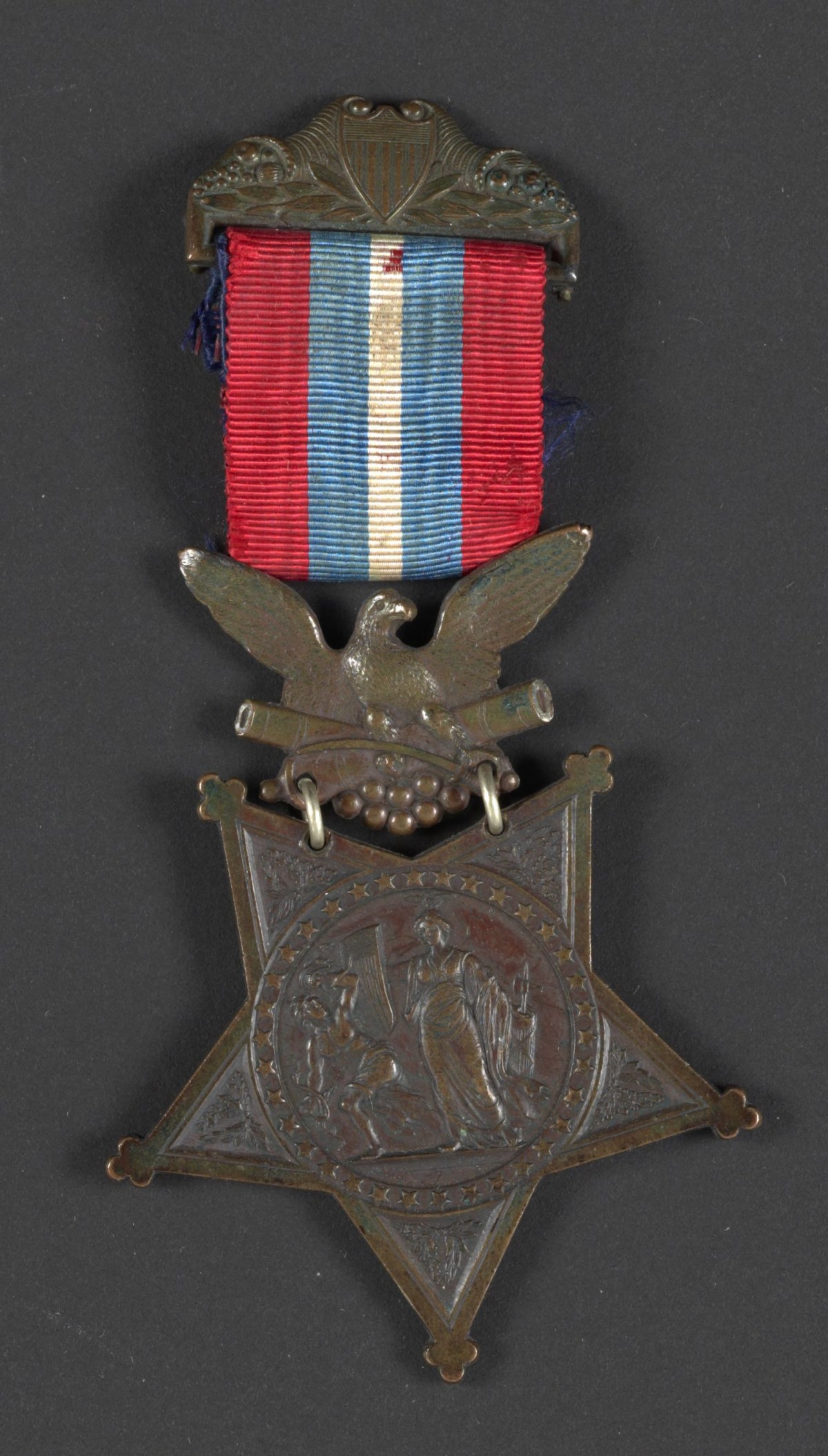
In this critical moment, Chamberlain made his second brilliant decision.  He spoke one word…understood by everyone.  “Bayonet”.  With that one word, every man affixed his bayonet to the end of his rifle.  He then ordered the men at the right angle to swing around and form a single straight line with the rest of the regiment, and at that point down the hill they charged, surprising Oates’ men.  They would take several hundred prisoners during that charge, and for his part in leading the 20th Maine, Chamberlain would be awarded the Medal of Honor for, as the citation reads, “Daring heroism and great tenacity in holding his position…”.  At the core of both of those words, heroism and tenacity, lies courage.

This is where it gets a little (who am I kidding) no…greatly uncomfortable, because it involves me writing about myself.  So, please bear with me while I unpack this part.  I don’t often talk about this specific experience in my life, but I want to describe something that happened during a deployment to Colombia, South America.  I lived in the jungle for a little over two months…yep, you read that correctly…I actually lived in the jungle.  Me and Rambo hanging out, barbequing wild boar that we killed on our hunt.  Ok, that part is made up…Rambo wasn’t with me.  But I did have barbequed wild board.  That is a story for another time though. Anyway, one day, myself and three of the five guys I was deployed with, were watching a Colombian helicopter flying around.  The pilot began hotdogging it and flying close to the ground…too close as we were about to find out.  We watched it enter a horseshoe-shaped clearing and then heard a loud thud, and then a high-pitched piercing sound, which we would shortly realize was the engine still trying to turn the rotors which were now stuck in the ground.  Knowing instantly that the helicopter crashed, I turned to the others and said, “Let’s go”.  I know this sounds like something out of a movie, but this really happened, and I really said those words.  We began to run across what we thought was simply an open field, but turned out to be a thick, mud-filled, boggy marsh.  (We later found out that this marsh was home to leeches and poisonous snakes.)  It took what seemed like an eternity to go those couple hundred yards, as each step had us sinking thigh-deep into the miry ground.  When we finally got to the helicopter it was on fire, the engine was still running, and there were injured bodies all over the place.  Now, one thing I failed to mention was that there were nine people on that flight…too many but the pilot didn’t care.  They were all injured, some worse than others.  One particular Colombian soldier had a pretty severe head injury, another had, we would later find out, several broken ribs and a punctured lung.  With the fire near the side-mounted machine guns (loaded with live ammunition), we had to work fast to get everyone moved to a safe distance before that ammunition started exploding.  We were also worried that the rotors would break off with pieces becoming flying projectiles.  Shortly after we got everyone off the helicopter and moved to a safe distance, the two firefighters we had deployed with us, arrived, and put out the fire.  I am skipping much of the details for the sake of the length of this post, but suffice it to say, it was a high-octane, high-stress moment.

Now, I share this because, like Joshua Chamberlain, I am just a normal guy.  Chamberlain was a professor who in a moment of crisis, answered the call.  I was a young staff sergeant who also answered the call when this other moment presented itself.  But that is where the similarities end.  Chamberlain was a New Englander from Maine, an officer in the army, who responded to the crisis on a hill in Pennsylvania.  I was enlisted, from the Midwest, who responded to the crisis in a jungle in Colombia.  We were worlds apart.  But crises don’t discriminate.  They don’t look at the color of our skin, our educational background, our upbringing, or anything else that differentiates us from the next person.  They just happen, and we must choose how to respond.

Again, I don’t tell that story very often because it kind of feels weird to do so.  By the time I returned home from Colombia, news of the event had already made its way to my leadership.  As a result, I received a very high military decoration for what I did.  Every time I wore my service dress uniform, people would ask about it.  Sometimes I told the story, other times I did not.  When I did, I wanted them to know it wasn’t just me.  It was all of us.  When the crash happened, I didn’t think about the consequences.  I just acted.  If I hadn’t been there to say those words “Let’s go”, I want to believe someone else would have, because I feel there is an intrinsic element of courage in us that is ready at a moment’s notice to jump into danger and help if needed.  I cannot explain why one person responds and another looks away, or why one person lends a helping hand and another pulls out their cell phone to film it.  Perhaps that courage I referred to earlier is buried too deep in some.  Let me say again, there is nothing special about me.  I just happened to be there, so I acted.  I guess when I tell this story, it is because I want others to know that they can be courageous as well.  In the end, the power is in how each responds when called…it’s that simple.

“Have I not commanded you?  Be strong and courageous.” (Joshua 1:9)