Holy Leadership, Batman

My all-time favorite TV show is the Batman series from the mid-1960s.  You know, the one starring Adam West and Burt Ward.  I can watch that show anytime, even if it is an episode I’ve seen dozens of times…and for the record, I’ve seen every one of them dozens of times.  I am not sure why I like the show so much, for it is quite ridiculous.  I mean, how can you not tell by the voice that Bruce Wayne and Batman are the same person?  And by putting on a black eye mask, Dick Grayson suddenly looks nothing like Robin?  Then there is Batman’s utility belt – it has everything a crime fighter could ever want or need.  Need to scale a 20-story building.  No problem, the Bat utility belt has rope and a grappling hook.  Need to get that pesky shark off your leg?  No worries, grab the can of shark repellant from the trusty Bat utility belt.  Got a headache?  There’s a Bat Pill for that.  Need to protect yourself from being hypnotized by a siren?  There’s a Bat Pill for that.  Need to counteract a deadly concoction that was slipped into your drink seemingly without your knowledge?  There’s a Bat Pill for that.  There’s a Bat Pill for literally everything under the sun.  And they are all inside the Bat utility belt.

Then there are the villains.  The Joker, Riddler, Penguin, Catwoman, Egghead, Mr. Freeze, and many, many more.  They are self-described brilliant minds.  Yet none of them could figure out how to permanently get rid of the dynamic duo.  The best part of each episode occurred when the “guest villain” of that week, captured Batman and Robin, and then put them into an absurd “death trap”.  And instead of waiting around for a few minutes to see the two breathe their last, they leave in a hurry so that they can carry out their dastardly crime.  I remember one particular episode where Batman and Robin were tied to racks with a giant magnifying glass mounted over each of them.  Batman remembered that a solar eclipse was going to occur in just moments, so he tells Robin to angle the lens 14 degrees so that the sun will burn the wrist ties.  It had to be precisely 14 degrees.  One degree off and it would have been lights out for the crime fighters.  I’m chuckling as I write this because of how silly it sounds.

But I loved it because, in spite of all the corniness, Batman represented all that was good in man.  He would never break any law, even chastising Robin at times when the Boy Wonder suggested doing otherwise.  (There is one episode where Batman parks the Batmobile in front of a parking meter.  Batman pulls a coin out of…you guessed it, the Bat utility belt…and puts it in the meter.  Robin tells Batman that no policeman is going to ticket the Batmobile, but Batman responsibly instructs Robin that it is the right thing to do, and that parking meter money is used to pay for and maintain the roads.)  

Batman always seemed to want to see the best in everyone, including the villains he captured and recaptured (and recaptured) week after week.  Perhaps that is why I am so drawn to this version of Batman, and perhaps you are too.  You see, we should want to see the best in people.  We should want to see people succeed and come out on top.  If you are interested in becoming a better leader, at work, and at home, then this has to become a priority.  If you want to be in the business of helping others, you have to start by seeing the best in others.  The challenging thing is this…those you are trying to help will sometimes put you in a bad position.  They probably won’t tie you to a rack and try to fry you with an oversized magnifying glass until you’re crispy like bacon, but they might abuse your kindness, your patience, and even your time.  It doesn’t matter.  Your job is to keep coming back, looking through the flaws of the individual, and seeing their best.

Batman, of course, is fiction.  But there is one person who ALWAYS sees the best in us.  He was, is, and will forever be, the greatest leader ever.  Jesus.  

He knows your voice no matter what persona you might try to hide behind. When you try to put on a black eye mask, He still recognizes you.  If you have a 20-story problem that you need to scale…He is there with you.  Need relief from mental, emotional, physical, and spiritual pain?  He’s got you, not with a pill, but with a reminder found in His Word that He is your help.  Caught in a trap where there seems to be no escape.  Trust me there is.  His name, when called on, will provide the way out.  And when you try to bend the rules a little, Jesus is right there to remind you that integrity is the best option.  

Providence on Purpose

In July of 1755, a young George Washington rode on horseback with General Edward Braddock, a British officer, and about 1,300 troops as they set out to push the French army out of the Ohio Country.  General Braddock set as his target, Fort Duquesne.  Nearing the fort, the British army were attacked by a combined force of French soldiers and several Indian tribes.  Unaccustomed to guerrilla-style fighting within tree lines, the British were beat back.  To make matters worse, British soldiers began firing into their own lines, thinking they were instead shooting at the French.  This led to mass chaos and immediate retreat by the British.  To help clear the battlefield confusion, Braddock rode forward, but was struck down with a mortal wound.  His men grabbed his body as they continued the retreat.  

Washington now realized he had to step up and provide leadership in the absence of the dying Braddock.  He rallied the British to establish a rear guard that allowed some soldiers to retreat safely.  While doing so, Washington had two horses shot from underneath him.  But each time, he climbed onto a horse belonging to another fallen warrior.  If not for Washington’s actions, more British would have been captured and killed.

Once safely down the road, Washington took stock of what happened.  Recalling the event in a letter to his brother, Washington wrote, “But by the all-powerful dispensations of Providence, I have been protected beyond all human probability or expectation; for I had four bullets through my coat, and two horses shot under me, yet escaped unhurt, although death was leveling my companions on every side of me.”  Why hadn’t Washington been hit when so many of those around him lay on the ground dead and dying?  The Reverend Samuel Davies might have understood the reasoning better than anyone.  Upon hearing what occurred, he wrote, “As a remarkable instance of this [his bravery], I may point out to the public that heroic youth, Colonel Washington, whom I cannot but hope Providence has hitherto preserved in so signal a manner for some important service to his country.”

Providence.  Preserved.  Service.  Three thought-provoking words.  

Both the colonel and the good reverend understood that divine Providence had intervened.  Now, there is no shortage of critics who want to convince us that George Washington did not believe in God.  They cite all kinds of facts to include he rarely took communion, or that he rarely attended church.  But the fact of the matter is Washington spoke and wrote about God quite liberally, even commenting that he himself might turn preacher when his current duty as the commander of the army ceased.  Washington believed that an all-powerful God had protected him.

Davies too, believed, quite correctly, that God had preserved Washington’s life in that moment, where bullets were whizzing around and through his jacket, for some greater purpose.  It wasn’t poor marksmanship by the French and Indians.  It was God’s hand preserving Washington’s life.  And why had God’s hand preserved Washington?  Because the colonel was needed for a greater service, as Davies wrote.  The rag-tag group of colonies needed a resolute commander for its army.  After the war, these same colonies needed a voice of reason in establishing a Constitution.  And the fledgling United States needed a man of remarkable experience as its first president.

So, was it the fickle fingers of fate, or the guidance of God’s Providence? George understood what Isaiah the prophet had written some 2,500 years earlier, “Fear not, for I am with you…I will uphold you with my righteous right hand.”

Density of Purpose

George is on a mission.  He has to talk to the girl of his dreams, because Darth Vader from the planet Vulcan told him so.  It is either do that or Vader will melt his brain.  So George walks into the diner and over to the booth where his love interest sits, and emphatically states,  “I’m your density…I mean, I’m your destiny.”  George McFly has begun his journey of destiny that will end with him kissing Lorraine near the end of the movie Back to the Future.

We talk about destiny quite a bit, even if at times it is done in jest.  We’ve all heard, “It was destined to be this way,” or perhaps, “My team was destined to win.”  To think seriously like this though, is to act as if we go through life at the mercy of luck.  But is that true?  Do we live dependent on chance, luck, fate?  I believe the moment we surrender to fate is the moment we stop pursuing purpose.  And when we stop pursuing purpose, all kinds of bad things happen.  More about that in a moment.

Douglas MacArthur promised, “I shall return.”  President Kennedy challenged, “Ask not what your country can do for you; ask what you can do for your country.”  Martin Luther King Jr said, “If it falls your lot to be a street sweeper, go out and sweep streets like Michelangelo painted pictures. Sweep streets like Handel and Beethoven composed music. Sweep streets like Shakespeare wrote poetry. Sweep streets so well that all the hosts of heaven and earth will have to pause and say, here lived a great street sweeper who swept his job well.”  These men understood that to truly lead, you must have purpose.  

MacArthur had to flee the Philippines, but he vowed to come back.  He made it his number one purpose.  Kennedy reminded his listeners that purpose is not fulfilled through the benefit of receiving, but rather through how much the individual gives back.  King perhaps said it best…if you end up being a janitor, then become the best janitor you can possibly be.

Every great leader understands that leadership and development is not about themselves, it is about others.  They also understand that leadership involves purpose and intentionality, not about leaving the outcome to chance or fate, or in this case, destiny.  Leaders need to believe that how they interact and communicate with others is not left to chance.  Imagine if MacArthur wagered his return on chance.  He would have failed.  So do leaders when they are not intentional and purposeful.  When they fail at that, they can find ourselves on a lonely journey, leading no one.  When that happens, many things come into question…their integrity, their reason, among others.  But those who lead with purpose attract others, to the point where they are able to successfully pass the baton to the next generation.

George and Lorraine made a strange pair in the past, but George had one thing right.  They were meant to be together.  They would marry and have a good life “in the future”.  So George really was Lorraine’s density…I mean, her destiny.

Not Just Another Flesh Wound

One of my favorite individuals in all of history is Theodore Roosevelt.  He’s a favorite for so many reasons.  As a child, he suffered from a sickly body, including chronic asthma.  When the family vacationed abroad, young Teddy often had to be taken by his father to an environment away from the big cities, breathing in the cleaner, country air.  To overcome his weakened frame, he began to exercise, including taking up boxing.  He was never good, but it did not matter.  He used various forms of exercise to build up his stamina, and through that, he became healthier.  In other words, he didn’t let limitations hold him back.  This was on full display in October 1912.  While preparing to give a political speech, he was shot.  Anyone else would rush to the hospital, but not Roosevelt.  He told the crowd that he had just been shot, but intended to speak anyway, which he did…for 90 minutes!  Talk about overcoming obstacles…the man had a bullet lodged inside him, and he went ahead and gave the speech.  This was one time being a long-winded speaker saved a life. (The shot entered  his coat and tore through the 50-page speech folded inside the pocket, slowing the bullet down before it could reach the heart.)  I also admire the man because he was a progressive thinker.  Even though he was a Republican politician, he worked with all people in an attempt to make the nation better. I like too that he was visionary. He recognized early on that the country’s most beautiful scenery had to be protected from land developers.

Now, was he flawed?  Yes.  Did have shortcomings?  Absolutely.  I would have to say that my least admired moment of his life is how he reacted to, hands down, the worst day of his life.  On February 12, 1884, Roosevelt’s wife, Alice gave birth to their daughter, Alice Lee.  Two days later, Roosevelt’s life was flipped upside down when both his mother and wife died just hours apart.  It would be enough to bring anyone to their knees, including Theodore.  So, after less than four months, he left his daughter in the hands of his sister, “Bamie,” and traveled to the Dakota Territories, where he spent seven of the next twelve months ranching and hunting.  I simply cannot imagine handing my newborn child off to someone and leaving for months, but Roosevelt felt like he had to get away, to escape the sadness.  In fact, the loss of his wife was so painful for Roosevelt that he would not allow his first wife’s name to ever be spoken in his presence again.  His daughter Alice, named after her mother, would be known as “Baby Lee,” and in adulthood, as “Mrs. L.”

As humans we react to tragedy differently, and perhaps I am being somewhat judgmental of Roosevelt.  He felt that it was the best for him and little Alice Lee to leave and get away.  But the real question today is, how do we, as leaders in our respective bubbles, respond to troubles or tragedies.  When bad things happen, what do we do?  Do we stand our ground?  Do we retreat?  Do we stick our heads in the sand and ignore everything?  Do we pretend that everything is great, when it really is not?  It is often these moments that define us.  We should remember what the Psalmist wrote: “I lift up my eyes to the mountains, where does my help come from? My help comes from the Lord.”

Fortunately for Roosevelt, he was a man of great courage, who stood up against corruption as a New York Assemblyman and Police Commissioner; who fought up San Juan Hill in Cuba; who envisioned protecting some of the nation’s most exquisite landscapes by creating the national park system.  And because of these moments, we might forget that the man who walked around the last six years of his life with a 32-caliber bullet inside him, once ran away.

Hills

Study the history of warfare very long and you’ll find a consequential battle that two armies clashed over to gain the high ground.  As long as men have fought, the high ground was always desired.  From there the battlefield commander can see enemy strengths, movements, and placements of strategic importance.   

At Bunker Hill (though most of the fighting took place on a smaller rise named Breed’s Hill), the Colonials battled the British, showing the much better organized, trained, and equipped Red Coats, that scrappy militia men were not to be taken lightly.  It would serve to further ignite the passion of freedom-seeking revolutionaries.  On the third day of fighting at Gettysburg, the Union Army repelled multiple waves of attacking Confederates along Cemetery Ridge, causing the bruised southern army to retreat back to Virginia, and turning the tide of the entire war.  It would prove to be the bloodiest battle Americans ever fought. On Hill 593 at Monte Cassino, the German army successfully beat back several attacks by the Allied Powers.  Day after day, American soldiers battled to get that expensive piece of real estate. Normandy, Hamburger Hill, Takur Ghar, and countless others are highlighted in our history books as significant moments of battle, focused on gaining the upper hand, and the “upper land”.  Simply put, the hill is important, and in some aspects, crucial.  

Capitol Hill, where battlefield gunfire and cannons are replaced by verbal attacks and character assassinations.  Sadly, today’s culture hears more about the shenanigans that occur here every day, than the heroic events on hills of times past.  And if the past is a picture of things to come, there will never be a victor; there will never be a loser; for it is a perpetual battle.  We need to claim a victory…and not a Republican one, nor a Democrat one.  We need a victory that rises above all this.  Our hope is found in what can only be described as, hands down, the greatest hill battle ever fought…Golgotha.

If there was ever a one-sided battle, this was it.  One man against the legions, the hordes, the masses of darkness.  Evil on all sides.  Crushing despair.  One man mocked, beaten, whipped, punctured, pierced, bloodied, and finally, nailed to a cross.  One man down for the count.  Or so it was thought.  You see, it WAS a one-sided battle.  One the enemy never saw coming.  Thinking they had won, the legions began to celebrate.  After all the tomb had a resident.  But then, the remarkable…no, the miraculous, occurred.  The heart began to beat.  The lungs filled with air.  Synapses started firing.  Tissue came to life.  And then…the supposedly defeated one, opened his eyes.  The face of love returned. The Father and Son were reunited.  And the tomb had a sudden vacancy.  Jesus took the hill.  He conquered the mountain.  And the Son of God now occupied the high ground. 

Treasure

Gutzon Borglum was the best, or at least he thought so.  No one else was up to the challenge of, what must be considered, his greatest work.  Doane Robinson must have thought so as well, for the South Dakota resident began a correspondence with Borglum about a project that would loom large over his state’s vast frontier.  Excited at the prospect, Borglum immediately traveled to listen to Robinson’s idea, and would eventually agree to taking on the work, with a major adjustment of course.

Robinson had the vision of creating a massive monument celebrating heroes of the West.  However, Borglum wanted it to be greater…celebrating not Western heroes, but heroes of the entire United States; Washington, Lincoln, and others.  Robinson agreed and began the laborious task of gathering support.  At times, it would prove nearly insurmountable, and while the monument would face (pun intended) many other obstacles over the years, none would rival the financial burden that at times stopped the work completely.

All that aside though, on August 10, 1927, with President Coolidge in the audience, Borglum ceremoniously drilled six holes into the side of the mountain.  The project had officially started, though it would be another two months before actual work began.  In 1930, George Washington’s face was dedicated in a ceremony.  Six years later, Thomas Jefferson was dedicated, and a year after that, Abraham Lincoln was dedicated.  The final face, Theodore Roosevelt, was dedicated in 1939.  Work continued on all four Presidents until the end of October 1941.  Sadly, Borglum died seven months before the completion, forcing his son Lincoln (named for the President) to finish the work started by his father 14 years earlier.

Mount Rushmore is a remarkable sight to see.  My family traveled there this summer to see the four “larger than life” faces carved into the side of the mountain.  It got me thinking though of the similarities between this monument, a national treasure and us, the treasure of God.  Now, depending on where you are in life, you may not feel treasured by God, but rest assured, you are.  Exodus 19:5 is just one verse that reminds us that we are indeed God’s treasure.  

In the original plans for Mount Rushmore, Jefferson’s face was going to be on Washington’s right.  The blasting and carving was well underway.  His face had begun to take shape.  But then, something unplanned occurred.  The rock was found to be too unstable.  As a result, it was blasted away and carving began to the left of Washington.  Like Mount Rushmore, you and I face obstacles that would love to see us fail.  We may be going along in life, and suddenly, something happens that forces us to change directions and go somewhere we never imagined.  We might be inclined to call these detours of life, but are they not really God’s way of getting our attention, oftentimes preventing us from going down a path that leads to destruction?

During the years’ long work, the carving was done by blasting away the outer rock.  Once that was removed, workers drilled a series of holes into the rock face, through a process called honeycombing.  They would then be able to chip away the remaining rock, shaping it into the faces of the Presidents.  Sometimes God has to use spiritual dynamite to clear away things in our life…things that are not healthy for our walk with Him.  Other times, he uses precision “honeycombing” to get the results needed for that closer relationship.  Isaiah 64:8 says that we are the work of His hand, and Philippians 1:6 reminds us that God has begun a good work in us which He will complete in His time.

Looking at the faces from a distance, it seems as though the surface of the rock is smooth and flawless.  But take the time to examine up-close photos and you realize how wrong you are.  Their faces are anything but flawless.  There are veins of discolored rock that run through all four Presidents.  Imperfections mar cheeks, lips, eyelids, chins, and foreheads.  There is nothing smooth or flawless about their likenesses.  Similarly, from a distant, it might look like we have it all together…that we are perfect.  But when examined up close, it is quite apparent that, in fact, we are not.  We have flaws, and not just the facial blemishes that we try to cover with make-up.  We say things we should not.  We judge others when we know it is wrong.  We act on behaviors that we later regret.  We are… well, flawed.  “But God shows His love for us in that while we were yet sinners Christ died for us.” (Romans 5:8)  So, even though we explore paths we should not, God loves us.  Even though we carry extra baggage that needs to be blasted away, God loves us.  Even though we, so ineffectively, pretend to be perfectly put-together creatures, God loves us.  We are, after all, His treasure.

July 3, 1863…Last Full Measure of Devotion

“Four score and seven years ago….”  So starts one of the most recognizable speeches in American history.  On the 19th of November 1863, Abraham Lincoln stood on a make-shift platform in Gettysburg’s Evergreen Cemetery, and spoke for a few moments.  David Wills, a resident of Gettysburg, invited the President to, in a sense, sanctify the hallowed grounds of one of the nation’s bloodiest battlefields.  It might seem unthinkable in today’s environment to ask the President of the United States to hop on a train, spend the night in town, wake up the next morning and sit through a 3-hour program.  Yet, this was exactly what Lincoln did.  And then he spoke for only a few minutes.  Now, we would be appalled if this occurred, but Wills intended for Lincoln’s speech to be brief for in his invitation to the President, Wills asked him to provide “a few appropriate remarks.”

In his few appropriate remarks, Lincoln pointed out, that while he and others were there to dedicate this piece of sacred soil, in reality there was nothing they could do that was not already done.  Let me highlight just two of the ten sentences he spoke that day; “But, in a larger sense, we cannot dedicate – we cannot consecrate – we cannot hallow – this ground.  The brave men, living and dead, who struggled here, have consecrated it, far above our poor power to add or detract.”  The devotion, the consecration, the sanctification, the dedication, had been done four and a half months earlier.  Brave men had done what no one else, not even President Lincoln, could do. 

On that hallowed ground, two great armies fought for the first three days in that previous July.  Over and over again in epic battles, soldiers displayed incredible bravery in the face of certain death.  Today, as one tours the countryside that bore witness to the devastating carnage of fighting between the North and the South, you cannot go far without seeing a monument dedicated to a regiment, brigade, division, or an entire corps.  There are numerous statues honoring individuals involved in the fighting.  Some are more extravagant, and thus, more noticeable, than others.  There is the larger-than-life statue of General George Meade, the Union Commander, astride his horse.  Major General John Reynolds has three monuments dedicated to him, and he never saw any direct action at Gettysburg as he was killed as the battle began to unfold.  Then there is the statue of Major General Gouverneur Warren atop Little Round Top, with binoculars and saber in hand.  He is credited with identifying a gap in the defensive lines and ordering men to extend the line of battle to protect against any flanking movement of the enemy.

But at the Union line on top of Cemetery Ridge, there is a small, unassuming, granite marker bearing the name of an artillery officer killed during the Confederate attack on July 3.  First Lieutenant Alonzo H. Cushing, the commander of Battery A, Fourth United States Artillery, was one of the thousands that gave his life on that day.

Cushing was born in Wisconsin, but raised in Fredonia, New York.  He attended the United States Military Academy, 400 miles to the west.  He graduated twelfth out of thirty-four cadets, and was commissioned a second lieutenant in June 1861.  Before long, he found himself on the battlefield at Bull Run, engaged in his first fight with the enemy.  Cushing, at the time, was a member of Battery G, Second U.S. Artillery.  He also saw action at Antietam, serving then as one of General George McClellan’s aides, and it was during the May 1863 battle of Chancellorsville that Cushing was promoted to the temporary command of Battery A, Fourth U.S. Artillery.

Cushing’s Battery A consisted of six 3-inch Ordnance Rifles which fired a shell that weighed between eight and nine pounds.  It was very accurate hitting the intended target up to a mile away.  On the afternoon of July 3, Cushing’s battery, along with numerous other artillery batteries, would be tested during the famous charge named for the Confederate general, George Pickett.

The artillery duel between the Union and Confederate batteries lasted for what must have seemed like eternity.  Thousands were killed or injured as a result of the barrage of cannon and gunfire.  In the heat of the battle, one of Cushing’s sergeants attempted to head to the rear, reportedly to get a replacement wheel for one of the rifles, but Cushing stopped him, threatening to shoot him if he abandoned his post.  Some moments later three of Cushing’s limbers were hit by enemy fire.  Cushing suffered a wound to his thigh.  It would not be the last time he would get hit on this day.

As his battery continued to get torn apart, Cushing approached Brigadier General Webb, a brigade in the Second Corps, and asked him if he wanted to pull his damaged rifles out of the way for undamaged batteries.  Webb told him to stay in place for they would need everyone on the line.  Cushing then asked permission to move his last two rifles to the stone wall in front of him to avoid shooting over the heads of Union men.  Webb agreed to the request.  After moving them, Cushing had soldiers load the two rifles with whatever they could find…pieces of broken shell, stones, bayonets…and then fired.

Cushing was struck by a second bullet, this time in the shoulder.  Still, he refused to stop.  When the Confederates were less than a hundred yards from the Union front lines, Cushing received his third injury, a severe abdomen wound.  One of the men of his remaining rifles went down, and Cushing rushed in to replace him.  When firing an Ordnance Rifle, one of the men must cover the vent hole with his thumb, protected by a leather thumbstall.  Cushing did not have one, and there was no time to retrieve it from the downed soldier, so he covered it with his bare thumb, resulting in it being scalded to the bone.  At one point, he was told to get medical treatment for his wounds, he responded by saying that he would remain right where he was, and either fight to victory, or die trying.  Sadly, it would be the latter.  As he gave orders to adjust the range of the firing, he was hit a final time by a bullet.  This time Cushing was struck in the mouth, killing him instantly.

One hundred fifty-one years after giving his “last full measure of devotion”, Alonzo H. Cushing was posthumously awarded the Medal of Honor.  The citation accompanying the medal states that he distinguished himself by acts of bravery above and beyond the call of duty….”  He certainly did.

True 20/20 Vision

He was described as homely, hatchet-faced, not handsome, gaunt, awkwardly different, uncomely, odd-featured, lean and ugly in every way, and having a most ungainly mass of arms and legs ever seen.  His first official photograph had to be doctored to draw attention away from his overly long arms and neck.  Even his wife said he was not pretty. 

He was constantly worried about his appearance and reputation.  He rarely smiled, not because he was never happy.  The culprit for his less than joyous demeanor was his teeth, or rather dentures.  The myth lives on that his teeth were made of wood…they weren’t.  Instead, his dentures were made from ivory, other people’s teeth, lead, tin and copper alloys, and even possibly a cow’s teeth.  The pain derived from his dentures stayed with him for most of his life.

He was a physically-uninspiring young boy.  He suffered from asthma and was generally confined to indoor activities such as reading.  Because of his frailty, he was kept from playing with children his own age.  He suffered near-sightedness and an underweight body.  In short, he was not the image of a healthy boy.

He was said to have uncommonly long arms.  His hands and feet were oversized.  He stooped a little, and when sitting, he slouched more than usual.  His chin, too, as was said, was longer than normal.

The human eye.  Made up of thirty different components, it is one of the most incredible, complex organs of the body.  Many don’t realize it, but your eyes see the world upside down.  Because of the process of refraction and the convex shape of your lens, the image that initially hits your retina is inverted.  Your brain then takes the image and puts it in the right perspective, that of right-side up.  Now, it is way more complicated than that and if I were a ophthalmologist I would be able to explain it better.  

However, for all of the intricacies of the human eye, it only sees what is visible.  With the assistance of technology such as x-rays, cat-scans, MRIs, and surgical cameras, the eye can see the inside of the body and the condition of bones, the heart, lungs, kidneys, etc, but it is still only sees that which is physical in nature.  

The human eye is amazing, but it only saw the homely, hatchet-faced, ungainly mass of arms and legs of Abraham Lincoln.  The human eye is extraordinary, but it only noticed the grim, joyless face of George Washington.  The human eye is fascinating, but it only recognized the frail body of a young, asthmatic Theodore Roosevelt.  The human eye is remarkable, but it only distinguished the longer-than-normal arms and chin of Thomas Jefferson.

The human eye could never see the most powerful nature of these men…that which made them who they were.  It was not their physical appearances that made them great.  If this were true, they all would have started with two strikes against them.  If ever the old saying “you can’t judge a book by its cover” rang true, it was in the lives of these four men.  But isn’t that just what we do…judge by the externals, the appearances?  Beautiful face – check.  Six-pack abs – check.  Toned muscles – check.  Meanwhile, we pay no attention to those who do not have the photographic appeal.

Such was the case in the Old Testament book of First Samuel.  God instructs the prophet to go and anoint one of Jesse’s sons as the new king.  Upon arriving, Samuel begins the selection process.  First up was Eliab.  I don’t know for sure, but I think he was handsome, had the muscles, and of course, the requisite six-pack abs – for who would ever want a king without those?  Samuel must have thought to himself, “This is the easiest job ever, Eliab is the chosen one.”  But suddenly God intervenes.  “Sam, it isn’t this guy.  I know he is fine-looking.  However, I the Lord, do not use the human eye to judge the capabilities of man.  Sam, I understand that you look at his physical appearance and believe Eliab is the one.  But it is not so.  I look at the heart.  I see what is on the inside of man.  I know how a person is going to react to adversity.  I know that when the going gets tough, you think that a man’s muscles are going to pull him through.  But you are wrong.  It is who he is on the inside, that which is invisible to your human eyes, that will lead him through the storm.  That is what is important, Sam.”

And storms these men went through.  Lincoln held together a divided nation.  Washington led a rag-tag, ill-clothed, desperate group against a professional army, and won.  Roosevelt mourned the loss of the two most important women in his life, his mother and his wife, within twelve hours of each other.  Jefferson drafted the Declaration of Independence, one of the most important documents in our nation’s history, which would have the effect of a revolutionary war.

We have honored them by having their likenesses carved into the side of a mountain, not because they were particularly good looking or had six-pack abs.  Their faces are memorialized because of what the eye could not see in them.  Because that is what is important.

Unassuming Leadership

Sergeant Alvin York hailed from Pall Mall, Tennessee, a tiny speck on the map.  He was a conscientious objector, but went to war anyway.  On October 8, 1918, he and 17 others captured a German unit during the Meuse-Argonne campaign.  Getting no rest, they soon found themselves under heavy fire again.  Nine of them were quickly killed or injured by the enemy guns.  Unharmed, Sergeant York, an expert marksman, killed the Germans one by one.  Several Germans tried to overpower their position, but York was going to have none of that.  He unholstered his pistol and shot them all.  The remaining Germans surrendered rather than face the alternative.  Sergeant York and the surviving members of his small unit escorted the prisoners back to the American line, capturing even more on the journey.  In the end, they had killed dozens of enemy soldiers, and gathered more than 130 German prisoners.  As a result of his bravery, he was honored with several decorations, to include the Medal of Honor.

Not wanting the attention that came with such a high-level decoration, Alvin York returned to the small town life in Tennessee, becoming of all things, a farmer.  Sergeant York and those cut from the same mold, inspire us to be more courageous.  Dare we call them heroes?  It would seem fitting.  Actually, it goes way beyond that.  To conquer an overwhelming force, and then return home and farm like nothing happened is what we would want all of our heroes to imitate.  To lavish in the limelight, though surely deserved if for a moment, seems to border on arrogance and pride.  Conversely, the best heroes are the unassuming kind, the ones that you would never recognize in a crowd.  And most of them want it like this. (For more information on Sergeant York, I recommend reading John Perry’s “Sgt York; HIs Life, Legend and Legacy”.)

Tucked away in the book of Judges, is the story of the mighty warrior, Gideon.  Most have heard of this Old Testament guy who “tested” God in order to confirm that he really was the one whom God wanted to use to defeat the Midianites.  I don’t think God could have been any clearer in His call to Gideon, but for the sake of the story, let’s recap how it all went down.

God first shows Himself to Gideon when the latter is secretly threshing the wheat so as to not be caught by the Midianites.  Gideon comes to the conclusion that God must be mistaken because he is the weakest member of his family which belongs to the weakest clan in all of Israel.  So there is no way that Gideon is having this conversation with God, or so he believes.  But God, in His everlasting patience, decides to humor Gideon’s reluctance.  God instructs Gideon to prepare a meal as an offering, and then immediately consumes it as fire springs forth from the altar rock.  I don’t know about you, but that would probably be enough to convince me that this conversation was legit.  But not Gideon.  He needs just a bit more evidence.  So he decides to ask God for another level of proof.  He tells God there is a fleece of wool that he proposes to use in the grand experiment.  Gideon will take the wool and place it on the ground, and if God is really calling him to lead the army, then in the morning, the fleece will be wet from the dew while the ground will be dry.  The Bible says that in the morning, “it was so.”  Again, one would think that this might be enough evidence to convince…but not Gideon.  He asks God for another “favor”…that is, don’t be angry with me but.…  This time, if God is really, really calling him, the fleece will be dry while the surrounding ground will be wet.  God once again does the remarkable and in the morning, the fleece is dry and, well, the ground is wet.

So now Gideon is convinced.  God really does want to use him.  And if the story ended there, it would be quite incredible.  But it doesn’t.  What God does next would blow the mind of every military strategist that ever was.  Instead of using the tactical advantage of a larger, overpowering army, God chooses to accomplish His objective with a minuscule-sized force.  If the situation was controlled by anyone other than God, it would be laughable.  Starting with a force of 22,000, God whittles the group down to a mere 300…this against an Midianite army that is described as filling the valley like locusts in abundance, and whose camels were without number.  Sounds big.  In any case, vastly outnumbering the 300 with Gideon.  Again, laughable, except that God does indeed control the situation.  God.  Alone.  Not Gideon.  Not the 300.

As Paul Harvey used to say, “Now, the rest of the story.”  Interestingly, Gideon is the only individual in all of scripture, called out by God as a hero.  And the crazy thing is, God called him a hero (Judges 6:12, NLT) before he did any of the heroic deeds that are synonymous with his story; even as he cowered in the winepress; even as he questioned God’s faithfulness in dealing with the Israelites; even as he challenged God’s decision to handpick him, the least of his family…the least of his clan.  Shortly after the victories over the enemy armies, the people clamored for Gideon to rule over them.  He replied that he was not going to do that.  Smart.  But what he decides to do next is a post-war blemish on his resume.  He has the people gather the gold from their spoils of war and bring it to him.  He fashions an ephod, a sort of vest, and places it in Ophrah, as a symbol.  However, his hometown crowd “prostituted themselves by worshipping it, and it became a trap for Gideon and his family.” (Judges 8:27 NLT).  In other words, he fell under the seduction of the crowd and worshipped a creation, rather than the creator.

One is hopeful that he recovers – Hebrews 11 seems to give us an indication that he does, for the writer includes Gideon in the chapter describing the faith of great men and women of the past.  What we do know though, is that, like Alvin York, he returns home and lives out the remainder of his days, dying at a good old age, fading, at least for the moment, into the background.  Like I said, the best heroes are the unassuming kind, the ones that you would never recognize in a crowd.  One gets the impression that Gideon, like Alvin York, would have it no other way.

The Kindness of an Umbrella

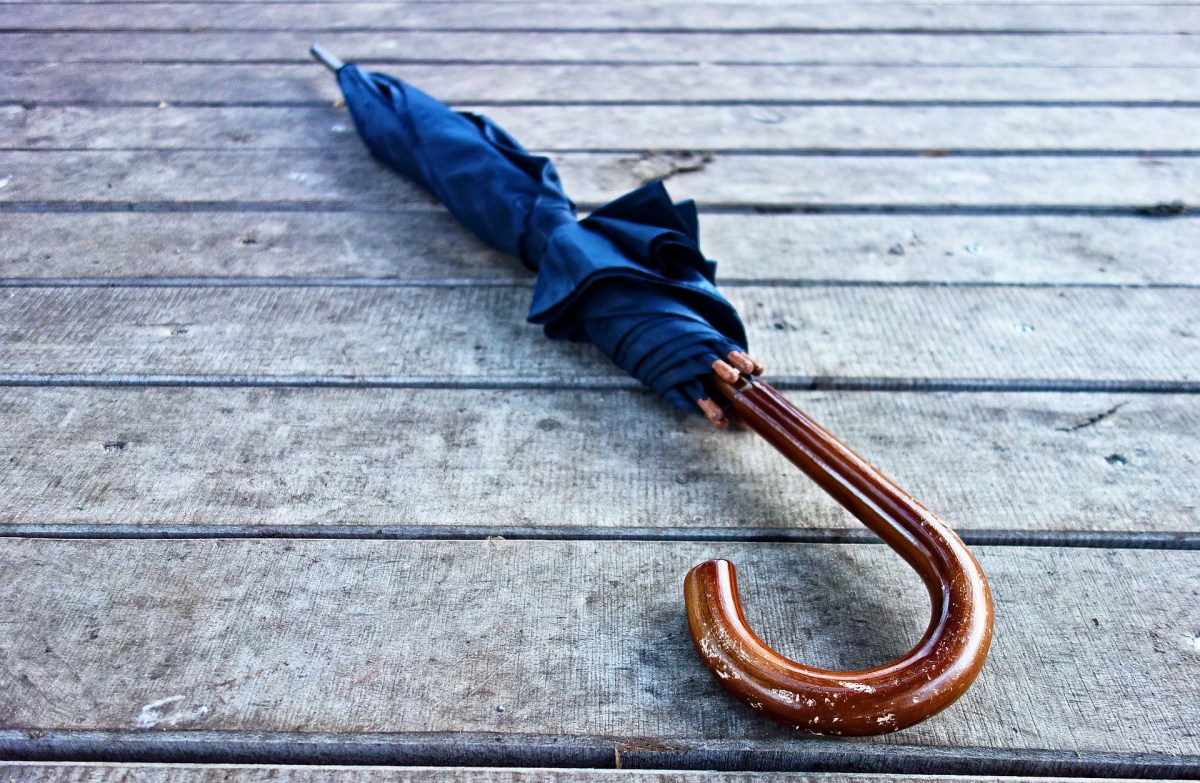
Stephen Cleveland might not be a name you immediately recognize.  It is more likely you know him by his “public name” – Grover Cleveland.  He was our 22nd and 24th President of the United States – the only one to serve two non-consecutive terms as the nation’s highest elected official.  Now, in examining the totality of his presidency, historians rate him, for a number of reasons, as an average president.  However, I recently read an account of something he did during his successor, Benjamin Harrison’s, swearing in ceremony.  That day was not a good weather day – our local weatherman would rate it at a factor of three – nasty!  It was a downpour, a deluge of rain.  Harrison would have been drenched as he took the oath of office.  Instead, he had some help.  No, it wasn’t a staffer, or one of his aides.  It wasn’t the vice-president.  It wasn’t Mrs. Harrison.  It was none other than the outgoing President, Grover Cleveland.  The man whom Harrison defeated in the polls to win the election held an umbrella over the incoming President, keeping him dry as he repeated the oath.  Kindness. On. Display.

This simple act should teach us the value of just being kind.  I am sure Cleveland was none too happy to be leaving the White House.  He surely did not want to lose his reelection bid.  In fact, I know this, for when the Clevelands were leaving, Frances, the First Lady, told the staff to take care of the furnishings because they would be back in four years.  She was true to her word.  In four years the Clevelands were back in the White House.

Kindness…it is a trait that is in short supply in the world of American politics.  It seems one party cannot work with the other.  Sadly, kindness is seen way too infrequently in our society as well.  One only has to watch the daily news or read comments in the online news feed or on social media.  Whatever happened to treating someone with kindness and decency?  It would seem it is a lost art.  What can be done to turn this tragedy around?  What is the cure for the circumstances we are in?  It is not difficult.  In fact, it is easy.  What is it?  I am glad you asked…

Travel back a couple thousand years and allow me to set the scene.  Jesus is turning communities upside down everywhere he travels.  We would definitely call his approach “outside the box”.  He’s doing and saying things that others are not comprehending.  Today, we have phrases like “give the shirt off your back” and “go the extra mile”.  We might think we’re pretty clever for coming up with sayings like these, but the truth is, Jesus taught his followers these principles at the beginning of his ministry.  It was Jesus who said that if someone sued you for your shirt, give them your coat too (shirt off your back); and if someone compels you to go a mile with them, don’t just go with them the one mile, go with them a second (go the extra mile).

So we fast forward a couple of years, nearing the end of his earthly ministry.  Jesus has just entered Jerusalem, preparing for his impending crucifixion.  And then it happens…this guy approaches Jesus.  He is, of all people, a lawyer.  The expert in all things law.  Now, I don’t know about you, but if a lawyer walked up to me unprovoked, the internal sirens are going to go off – “What does this person want with me?”  “Did I do something wrong?”  “Is someone suing me?”  But not Jesus.  He doesn’t think like this.  He patiently waits for the man to ask his question.  It’s really unfair though, because Jesus probably already knew the where the lawyer’s heart was.  Remember earlier that Matthew wrote that Jesus knew the thoughts of the crowd that was challenging him. (Matthew 12:25)  So I imagine Jesus knew this man was trying to test him.  It didn’t matter.  Jesus was prepared.  The lawyer asks his question, “Which is the great commandment in the Law?”

Note that he didn’t simply ask, “Which is the great commandment?”  No, he added “in the Law.”  In other words, what is the great commandment that I am bound to uphold because of the Law.  Now, anyone who has read the book of Leviticus knows that there are hundreds of laws and variations of those laws.  Any Jewish person would be bound to adhere to EVERY one of those laws.  At the top of the list would be to “love the Lord your God with all your heart and with all your soul and with all your mind.  This is the great and first commandment ”  That probably did not surprise the lawyer.  But what Jesus said next might have.  He once again turns the community upside down…the lawyer thinks Jesus is done.

“And the second is like it: You shall love your neighbor as yourself.”  Now, most people don’t go around ridiculing themselves, calling themselves names, hitting and abusing themselves.  Jesus, in this moment, is basically saying, because you don’t do those things to yourself, don’t do them to others.  And then he closes the conversation with this, “On these two commandments depend all the Law and prophets.”  In other words, EVERYTHING else hangs on these two statements.  All fails when these two commandments are not followed.  If you don’t love God with all your heart, soul, and mind, you are not going to love your neighbor.  If you don’t love your neighbor, you are not going to love God.  They are like bookends to life, holding everything else in its place.  You cannot have one without the other, and you cannot have anything if you don’t have these two.

Over in the book of Luke, Jesus tells the story of a good Samaritan who comes to the rescue of an injured traveler (who by the way came from a culture despising Samaritans).  Nevertheless, the Samaritan is the one who helps this stranger, when the stranger’s own people passed him by.  The Samaritan is the neighbor. The Samaritan, in one of the most beautiful pictures in scripture, was kind to this man; and the Samaritan’s kindness saved this desperate stranger.  We might do well to wonder what our kindness would do for another…

One more footnote on the life of Cleveland.  During the Presidential race of 1892, Cleveland was attempting to recapture the office from the man who defeated him four years earlier.  During the final months of the campaign, Harrison’s wife died.  This prompted President Harrison to stop actively campaigning for the office.  This shouldn’t surprise anyone.  However, Cleveland, in a show of kindness and respect, stopped campaigning as well.  Kindness. On. Display.