Tea is Only the Beginning…

Tea…the drink from which deals are made around the world.  In the Asian market it is usually green or white tea that holds prominence.  When I lived in Turkey, in every shop you walked into, the first thing the owner asked was if you wanted hot chai, or tea.  There was the usual regular chai made from black tea leaves, but if you were lucky, you could get apple chai.   It was the best.  You’d put a couple little sugar cubes in it and just enjoy.  Many evenings were spent haggling over prices for a Turkish or Persian carpet, all while sipping chai.  Of course, there is matcha which is really popular today.  It seems you can get matcha in pretty much any drink you want at the local coffee shop.  In England, Earl Grey tea is quite popular.  I’ve had it and I can honestly say, I’m not impressed.  In the United States, iced tea is the most popular form of the drink.  If you live in the South, it is served with a pound of sugar added, and in some restaurants, it is like drinking liquid sugar.  Growing up in the Midwest, we put a glass pitcher out on a hot summer day, and let the sun make the tea for us…hence, sun tea.

It’s not surprising that tea is as universal as it is.  But did you know it is also a powerful drink?  In fact, so powerful that it helped start a rebellion.  In 1698, England gave the East India Tea Company the sole rights to import tea into England.  British Parliament required the colonists in America to buy their tea from England, and thus the East India Tea Company.  But East India did not export their tea to America, so they sold it to companies that did.  This created problems with East India as they were losing money due to shippers bringing in smuggled Dutch tea.  So, to help East India, Parliament passed the Indemnity Act which lowered the tax imposed on the tea.  But nothing is ever simple, and this led to a decrease in revenue for Britain, so they responded by passing another law, the Townshend Revenue Act, which imposed a tax on the colonists.  This did not sit well with a lot of the colonists (cue Twisted Sister’s hit song “We’re Not Gonna Take It”).

Not taking it is exactly what the colonists did.  Furious with the whole “taxation without representation” thing, the colonists devised a plan.  On December 16, 1773, dressed like Indians, they boarded three ships docked on Griffin’s Wharf, and proceeded to smash open chest after chest of tea, and dumping them into the harbor.  By the time they were finished, forty-five tons of tea leaves were turning the harbor into an enormous glass of cold brew tea, valued at 10,000 British pounds (over 1 million dollars in today’s value).  King George could not understand why people would do such thing, and he did not take too kindly to these rebels destroying his profits, so more imposing laws came down hard on the colonists.  The British called them the Coercive Acts, the colonists labeled them the Intolerable Acts; so you can see the mindset of each party.  The acts served to punish Boston by closing the harbor until those responsible paid back the value of the tea.  The other aspects of the new legislation were even more painful for the colonists.  The Massachusetts government would essentially be run by a British elected official, who would, among other things, restrict any town meetings planned by colonists, stripping them of control and power.

One might argue that paying a little more for tea was not worth the punishments that followed.  Bostonians, at least some of them, disagreed.  However, for many, to just go along was no longer an option.  Today, we have a voice in our Republic.  In 1773, they were not so fortunate…again, the whole taxation without representation thing.  Those rebels felt that enough was enough, so into the sea went the imported tea.

Rebellion is a messy thing.  It was for those Bostonians.  It was for those in Philadelphia gathered to sign a document that sealed their fate.  It was for Washington and the rag-tag, under-equipped, underfed, undertrained, under-clothed army he led.  It is for the Christ-follower.  As Christians, we are in rebellion against everything that is of this world.  We walk by faith…not by sight.  We chase after love, joy, peace, patience, kindness, goodness, faithfulness, and self control…not jealousy, strife, anger, division, envy, and immorality.  We are long distance runners straining for a prize that is eternal…not sprinters seeking a medal in the here and now.  We serve in humility, considering others more important than ourselves…not boasting in our self-importance.  

Again, rebellion is a messy thing.  The book of Hebrews reminds us of rebels who went before us; Abraham, Moses, Rahab, Gideon, David, and many others.  Men and women who believed rebellion was the better way.  Abraham rebelled against those who said he was too old.  Moses rebelled against the pharaoh.  Rahab rebelled against her neighbors, refusing to give up the spies.  Gideon rebelled against every military strategist emphasizing numerical superiority.  David rebelled against the belief that the little guy never wins.  

Rebellious things.  Messy things.  They are not easy.  They are not popular.  The King Georges of the world will never understand.  Don’t worry though.  When we choose to be rebellious for God…we’re in good company. Who knows…maybe someday you will sit down with Moses and David, or Peter and John, and enjoy some hot apple chai. What a tea party that will be.

Succeed or Face the Axe

It was a tiresome and repetitive problem the president battled.  It seemed like he just could not find an appropriate commander for the Union Army…one that would, in his words, “fight”.  Lincoln desperately wanted a general who could match Robert E. Lee’s military strategy and aggressiveness.  George McClellan eventually became that general…Lincoln’s best hope for the North in those early years.  But it did not take long for a problem to arise…McClellan was indecisiveness and unable to commit his army to the fight, constantly believing the Confederates vastly outnumbered his own forces.  Finally, and after numerous prodding from Lincoln, the spring and early summer of 1862 saw McClellan and Lee fight up and down the Virginia countryside, with Lee generally being the aggressor, and claiming most of the victories.  Then in September Lee ventured north into Maryland, and the two armies collided at Sharpsburg, a small town 70 miles west of Baltimore.  The battle was especially brutal with nearly 23,000 casualties, making it the bloodiest day in United States history.  At day’s end, it was a draw, with neither side able to claim a clear cut victory.  However, the Union Army claimed a strategic win because Lee retreated from the battlefield.  But McClellan failed to pursue Lee, and it proved his downfall.  Lincoln made it known several times that he wanted McClellan to reengage the Confederates in battle, but the general refused to do so.  Lincoln had no choice…he sacked the general, and replaced him with General Ambrose Burnside.

This was not the first time Burnside’s name came up in discussion as the commander of the Army of the Potomac.  Twice before, Burnside had been offered the position, but refused it on the grounds of his inexperience.  This time was no different.  He again did not want the position, but heard that if he refused, the offer would go to Joseph Hooker, whom Burnside despised.  It was either take the offer, or risk having to serve under the man he did not like.  So, on November 9, 1862, Burnside reluctantly assumed command.

In just five days, Burnside, feeling pressured by the president who needed action, put together a plan to move the army south to capture the Confederate capital of Richmond.  The first stop was Fredericksburg.  On December 13, Burnside led the Army of the Potomac in a battle against Lee’s Confederates in what would become a devastating and humiliating defeat for the North.  Burnside, plagued by poor timing, committed his forces in piecemeal fashion against Lee who occupied the high ground.  Wave after wave of Union men walked uphill into a bloodbath.  Not knowing anything else to do, Burnside kept feeding the onslaught.  Relief came only as night fell, when his corps commanders finally talked him into ceasing operations.  It was another lopsided victory for Lee, with the Union suffering more than 12,000 casualties, against the Confederate’s 5,000.  Burnside made plans for another campaign against Lee, but when the weather refused to cooperate, Lincoln did the inevitable.  Burnside was removed and put back into his old corps commander position, but he never really recovered from the fiasco that was Fredericksburg.  In a twist of irony, Joseph Hooker, Burnside’s nemesis, was given the command.  Hooker, for his own part, would be fired after five months in the job.  It seemed as if the North was doomed to inept leadership.

[At this point, I’m guessing most reading this have never heard of Burnside.  But I bet I know what you thought when I first mentioned his name…sideburns.  The fact is, the term sideburns originated from Burnside’s facial hair.  Google a picture of him and you will understand.  Burnside had some serious sideburns.]  

Now, one can hardly fault Lincoln for giving Burnside the axe…or any of the other generals that simply could not perform under pressure.  To be appointed to that level of responsibility, you have to meet expectations.  To quote Peter Parker’s uncle, with “great power, comes great responsibility.”  Life is pretty much like this for all of us.  If we cannot meet our boss’s expectations, we face the prospect of getting replaced.  We might think it unfair, but our boss would say otherwise. 

I don’t know about you, but I sure am glad God doesn’t operate like that.  If God treated me like Lincoln treated his generals, I would have been kicked to the curb a long time ago.  I would deserve it, so it would certainly be appropriate.  However, God simply doesn’t work like that.  He calls us, equips us, empowers us, and leads us.   But then, like Burnside,  we make bad decisions.  Like Burnside, we don’t listen to the wise counsel of others.  Like Burnside, we keep repeating the same faulty thing over and over again, expecting different results.  And like Burnside, we deserve to be axed.  Instead, God corrects us…humbles us…nurtures us…and once again, tells us, He loves us.  May that be a reminder the next time you find yourself overwhelmed and facing disappointment.  Let the God of restoration pull you up from the miry muck of failure, and set your feet back on the firm foundation that He has established for your life.

Heads or Tails

Last week we briefly peered into the life of a man whose battlefield presence promised great victories, valorous leadership, and determined commitment matched by none.  And then reality set in and it was discovered that Benedict Arnold was concerned with himself only, which quickly led to him going down a dead-end road of destruction.  That is what someone with a lack of true character looks like.

This week we open the history book and find a very different kind of person.  A doctor, and no stranger to either side in the fight for independence, Joseph Warren was, simply put, the kind of leader you would follow.  It was March 6, 1775, and many had gathered in the Old South Meeting House in downtown Boston to commemorate the anniversary of the Boston Massacre, when British soldiers fired into a crowd of colonists, killing five of them and wounding another six.  Just by showing up at this anniversary event was considered by the British to be a crime punishable by death, but Warren seemed to care little.  He boldly stepped off the carriage, and walked into the building wearing a Roman-style toga, symbolic of defiance against the tyranny of the British government.  In the weeks leading up to his speech, Dr. Warren received numerous death threats, and even now, this day, one British soldier opened his hand revealing musket balls as a sign of intimidation.  Nothing would deter the speaker.

For 35 minutes Warren railed against the British government and the threat to liberty.  He highlighted the “wise measures recommended by the…continental congress,” but should those fail, “the only way to safety is through fields of blood, I know you will not turn your faces from our foes; but will undauntedly press forward, until tyranny is trodden under your feet.”  Then liberty would be established on the American throne.  He closed his powerful speech with the words, “You are to decide the important question, on which rest the happiness and liberty of millions yet unborn.  Act worthy of yourselves.”  Generations of free men yet to come hung in the balance as America decided what to do next.

If there were any doubts about whether Dr. Joseph Warren was an enemy of the crown before, those doubts vanished; and if there were ever a free choice for the direction Warren’s life would take, that too was now gone.  He was locked in on the fight for his country’s freedom.  Now, if Joseph Warren’s life as a patriot only consisted of speeches and verbal orders, it still might be enough.  For there were plenty of those.  John Adams never raised a musket in defense.  Thomas Jefferson never shed blood on a battlefield.  But that was not enough for the good doctor.  Warren had to become a man of action, and not words only, and so on April 19, 1775, he did just that, leaving the comfort of the lectern and walking onto the field of battle at Lexington and Concord.  In those hours, he directed the militia and joined the fighting as the British returned to Boston.  At one point a musket ball nearly ended his life.  It was a sign to come.

Nearly two months later, Warren showed up at the Battle of Bunker Hill and volunteered his service as a private in the militia.  General Israel Putnam thought it absurd that Warren would serve as a private under him, and instead told the doctor that it was he, Putnam, who should serve under Warren.  Warren declined and went of to fight.  The British assault was relentless, coming in three waves.  During the last attack, Warren stayed back to protect the militia during their escape.  Unlike the close encounter several weeks earlier, this time a musket ball found its mark.  Warren died instantly.    What occurred next could only be described as brutal.  The British, despising Warren because of the words he had spoken, now would enact their full revenge.  Although already dead, soldiers stripped off his clothes, bayoneted him until he was unrecognizable, pushed him into a ditch, and threw some dirt on him.  And for one, that was still not enough.  James Drew, a British lieutenant, went back two days later, dug up the body, spit on Warren’s face, jumped on his stomach, and then preceded to behead the dead American.  William Tecumseh Sherman quite appropriately said, “War is hell.”

My daughter recently came home with a shirt from the school play production.  On the back were the names of all the participants.  I wish I could say I was surprised that our last name was misspelled, but I was not.  It is not an uncommon experience.  But what made it frustrating was that we sent emails back and forth with spelling corrections, obviously a pointless venture.  I told her I was frustrated because there are relatively few things you actually own and can control in life, that nobody can take from you.  Your name is one.  

Solomon wrote, “A good name is to be chosen rather than great riches.”  Anyone who has his or her eye on a position of leadership, had better ensure they make this a priority.  The eyes that are upon you, will attach your name to your actions.  If those actions are like those of Benedict Arnold’s, your end is already written.  Your ability to have influence has met a dreadful death.  However, if like Joseph Warren, your actions are honorable and valorous, then there will be no shortage of people who will be inspired to follow your leadership.  Unlike the flip of a coin to decide the receiving team in an NFL game, the outcome is not random, a 50/50 chance, or a shot in the dark.  No, the outcome is in your control.  Today, decide that a good name is more important than riches, and act worthy of yourself.

The Role Peter Brady Never Wanted

You are one of the leading players on the team.  Your win/loss record is significantly better than any other pitcher on the team.  Everything would be great except the managers don’t recognize the talent you have.  Sure, you’re narcissistic, arrogant, you give yourself too much credit, and if it were not for those wins, you might not be in your position.  Some even say that you are difficult to play with.  So what should be done?  Should your manager bench you, and risk losing more games?  Does he trade you, just hoping that by doing so, he gets rid of a major headache?

If you know me, then you know there is a historical angle to this opening scenario.  As much as I love baseball, this is not a baseball story.  It is, instead, a story of a general who could have been famously great.  However, greed and arrogance got the better of him, until he spiraled out of control, landing in our textbooks as one of the greatest traitors in history.  

Benedict Arnold did not start out as the guy we love to hate.  He was talented, even described by some as one of George Washington’s best generals.  Arnold was a man of action.  When hearing of the Boston Massacre, he exclaimed, “Good God, are the Americans all asleep and tamely giving up their glorious liberties?”  As action was needed, Arnold acted.  Following the clashes at Lexington and Concord, Arnold organized a militia and marched to Fort Ticonderoga, joining forces under Ethan Allen, and easily defeating the small British detachment.  More than 80 cannons were transported from the captured fort to Dorchester Heights, overlooking Boston, which would eventually help force the British out of the city.

During the fighting at Saratoga, Arnold’s spirited actions contributed to a British surrender.  Unfortunately for Arnold, he suffered a serious wound, sidelining him for months.  In a brilliant move earlier in the war, Arnold pieced together an amateur naval force for a battle near Valcour Island on Lake Champlain.  He knew he was outgunned so his objective was to delay the far superior British Navy just long enough to get American forces time to prepare better defenses.  Arnold did better than that.  His maneuvering delayed the British long enough that they abandoned any plans to attack that year.  

With all of these accomplishments and more, Benedict Arnold should be a hero in our history books.  And yet, he’s not.  He was unscrupulous in his time as the military commander in Philadelphia.  He profited from dishonest business dealings.  Even worse, was the fact that he felt owed the money.  Why?  Because he believed junior officers were being promoted ahead of him.  Whatever the case, it was the beginning of the end of Arnold’s command in the American Army.  The last straw came when, after being appointed as commander of West Point, he set plans in motion to surrender it to the British in exchange for 20,000 British pounds and a commission as a brigadier general in the British Army.  As fate, or Providence (as George Washington called it) would have it, the Americans discovered the plot and foiled Arnold’s plan.  The man who could have been so much more, was now the villain in the story of our country.

What is it about ambition for power and prestige that destroys some men?  Arnold had an insatiable appetite for power and honor, and when it did not come, he turned his back on his countrymen for the equivalent of $400,000 today.  Think about what that means.  He was never able to return to his country.  For the most part, history is in no way kind to him.  Whenever you hear someone called “Benedict Arnold”, you know that the person is accused of being a no-good traitor.  In his hometown of Norwich, Connecticut, all of his family’s gravestones, with the exception of his mother’s, have been destroyed.  I don’t know about you, but there is no power worth having if it results in this kind of legacy.  Proverbs 11:2 says, “When pride comes, then comes disgrace, but with the humble is wisdom.”  Pride certainly ran deep in Arnold’s veins.  And because of that, he is a portrait of a disgraced individual.

Leaders today face many of the same challenges Benedict Arnold had nearly 250 years ago.  When the need for power and prestige outweighs the desire for service to others, then trouble is right around the corner.  Leaders can ill afford to make the same mistake.  Instead, leaders should be reminded of the necessity of humility in their daily interactions with others.  For in that there is wisdom.

**Now, let me explain the title of this blog in case you are not a Brady Bunch fanatic like myself.  In a season 4 episode, Peter auditions for the role of George Washington in the school play.  Feeling that Peter could handle the tougher role, his teacher gives him the part of Benedict Arnold instead.  Peter grudgingly accepts the role at first, but decides to quit when all of his friends start calling him a traitor.  Of course, mom smoothes things over, and persuades Peter to stay in the play as Benedict Arnold.

The Excellence of AA

She is, in one word, legendary.  Her story, as history knows it, begins with a chance encounter with John, a rather short and stout man who would one day rise to great importance.  But, because neither she nor John were much impressed with the other, the relationship almost never took off.  Add to that, her mother took an even less liking to John, so it is quite remarkable that her and John ever got together.

But as fate would have it, they married four years after that first meeting.  Abigail was 19 and John, nearly 29.  The Adamses would never look back.  John was off to his law practice, but Abigail was not content to just sit around.  She gave birth to six children in twelve years, ran the household, and was quite the financial wizard.  In the mid-1780s, Abigail joined John in Europe as he moved from the role of Envoy to France, to the Minister to Netherlands, and finally to the Minister to the United Kingdom.  In 1788, they returned home to Massachusetts, but in less than a year, John would be back in service to his country, this time as Vice-President.  In eight years, John would be elected to the office of the Presidency.

As was the custom, Abigail became the hostess for large gatherings in their residence.  But the year 1800 brought a major change in their residence, as the nation’s capital was moved from Philadelphia to Washington D.C.  Being the first family to live in the newly constructed home, it was a time of great excitement.  However, the Adamses only lived in the White House four months because John failed to get reelected to a second Presidential term.

Abigail was an anomaly during her husband’s presidency.  Today we think nothing of the First Lady being involved in work for the country, even to the point of diplomacy.  However, in the early days, and for decades following, it would have been unthinkable for the President’s wife to be involved in decision-making.  Abigail never fit that mold.  She routinely offered her advice and counsel to John.  In probably the most famous case of her involvement, and while John and the rest of the Revolutionary guys were busy with organizing a war, a government, and a country, Abigail wrote her husband a letter that has since become indelibly etched in our nation’s history.  She penned, “Remember the ladies, and be more generous and favorable to them than your ancestors.  Do not put such unlimited power into the hands of the husbands.  Remember all men would be tyrants if they could.  If particular care and attention is not paid to the ladies we are determined to foment a rebellion, and will not hold ourselves bound by any laws in which we have no voice, or representation.”  Abigail was not messing around.  Women’s rights were equally important as men’s, and she would do whatever she could to see it through.  It is unfortunate “the men” would not heed her words, resulting in 144 years of women having “no voice, or representation”.

There is a long line of individuals who owe much of their work in the women’s suffrage movement to Abigail Adams.  She was among the first to highlight the argument for equal rights.  Susan B. Anthony (ironically born in Adams, Massachusetts…named for John’s cousin and fellow Revolutionary character Samuel Adams), Elizabeth Cady Stanton, and Lucretia Mott are just three who gave their all to see women obtain the fundamental right to vote.  They have Abigail Adams to thank for starting it all.

Proverbs 31 contains these words, “she dresses herself with strength…she opens her mouth with wisdom…she looks well to the ways of her household…her children call her blessed…a woman who fears the Lord is to be praised.”  Powerful words to paint the life of an “excellent wife”…and powerful words to paint the life of Abigail Adams.  

To Travel and Speak

Betsey and James, living on a farm in upstate New York, celebrated the birth of their ninth child, Isabella.  However, even while happiness enveloped the couple, they were afraid for the new child.  They feared because of what the future might hold for the newborn.  They feared because they did not know how long they would be able to hold on to young Isabella.  You see, Isabella was born to slave parents, and Betsey and James were scared because they had children taken from them and sold to other families.  However, as fate would have it, Isabella would remain with her parents for the remainder of their lives.

By the age of nine, Isabella had lost both of her parents to sickness.  She was then sold for one hundred dollars to John Nealy.  This was problematic because the Nealys spoke only English, and Isabella spoke only Dutch.  Countless times Isabella misunderstood what Mrs. Nealy told her to do, and as a result, would get whipped.  One particular time she was summoned to the barn where Mr. Nealy was waiting with rods that were heated in a fire.  Nealy tied her hands together and whipped her back until it was completely bloody.  

Not long after that beating, Isabella was sold to the Scriver family.  Mr. Scriver was fisherman and a tavern owner.  Isabella was held by the Scrivers for about a year and a half, and then sold to the Dumonts.  It was during this time she met and was married to another slave named Thomas.  In the years that followed, she would give birth to five children.  

In March 1817, New York set in motion the process of freeing all slaves.  For Isabella, because she was born before 1799, she was not set to be freed until July 1827.  However, her master, Mr. Dumont agreed to free her a year early if she would work hard for the last year.  But due to a hand injury, Isabella was not able to meet Mr. Dumont’s expectations, so he refused to free her.  Instead of remaining a slave that last year though, Isabella fled and attempted to hide with another family.  Dumont found her though, and threatened to take her back.  Fortunately for Isabella, the family she was staying with offered to buy her.  Dumont accepted the offer and Isabella officially became a free woman.

Shortly after gaining her freedom, Isabella discovered that her son Peter was sold illegally to another owner in Alabama.  Isabella set out to get him back.  Everything was stacked against her, but Isabella went to court and won Peter back, one of the first black women to win in a court case.  A few years later, after serving a number of jail terms, Peter went to work on a whaling ship to, as he put it, help straighten out his life.  However, on one particular outing, when the ship returned to port, he was not on board, and was never heard from again.  Isabella was deeply saddened by the loss of her son.  Then in 1843, things drastically changed.

Feeling a call from God, Isabella left home and became an itinerant preacher.  It was also during these days that Isabella changed her name.  She would no longer be Isabella Baumfree…she was now Sojourner Truth.  When asked why this name, Truth replied, “The Lord gave me Sojourner because I was to travel up and down the land showing people their sins and being a sign to them…and Truth because I was to declare the truth unto the people.”  She wasted no time in living up to her new name, speaking against slavery, and often crossing paths with the likes of William Lloyd Garrison, Frederick Douglass, and others engaged in the abolition movement.  During the years of the Civil War, she helped recruit black soldiers, and fought for improvements in the Freedman’s hospital. 

In later years, she joined the suffrage movement, and in 1872, Truth, along with giants such as Susan B. Anthony, attempted to vote.  She was turned away at the polls.  Truth would not live to see the day when women would get the opportunity to vote, dying in 1883, 37 years before the Nineteenth Amendment was ratified.  But her work was not in vain.

The formation and existence of slavery was, and is, an evil institution.  It is inconceivable to have a child ripped from a mother’s arms and sold to another family, most likely resulting in the two never seeing each other again.  It is unimaginable to think that someone would be beaten based solely on the color of one’s skin.  It was, is, and will aways be a horrific stain on our history.  

But the thing that is most remarkable in this account is that Isabella stayed around and fought.  Having experienced the worst, she envisioned the best.  Not content to just eking out a living as a bystander, Isabella repurposed herself, even going so far as to give herself a new name.  Let me correct that.  God repurposed her.  God had much bigger plans for the woman who had witnessed enough pain and suffering for ten lives.   God needed to recruit someone who had “been there, done that.”  Isabella had been there, experiencing the brutal beatings, having lost loved ones to slavery, and on the receiving ends of condescending stares.  Isabella had done that, risking everything, running from captivity to freedom.  And in that moment, hearkening back to the spiritual truths that her mother taught her as a young girl, Sojourner Truth answered the call.  

No plantar fasciitis in Heaven

She really had no aspirations to be a runner.  It was her science teacher that saw the potential in the young girl.  One day after school, he was sitting on a train awaiting its departure, when he noticed her running toward it.  He thought there was no way she was going to get to the train before it pulled out of the station.  But the next thing he knew, she was sitting down next to him on the train.  What followed seemed like destiny.  He received permission for her to train with the Thornton High School men’s track team.  An invitation to join the Illinois Women’s Athletic Club came shortly after that.  To say that she had natural talent would be the understatement of the century.  In her very first official race, the 60-yard dash, she finished second to Helen Filkey, the world record holder in the 100-meter.  Just two days later, on June 2, 1928, she beat Filkey in the 100-meter, tying the world record time.  However, because of wind speed on the day of the race, it would not count.  No matter…the record would be her’s soon enough.  With such an incredible start, the trajectory of this young phenom would surprise no one.

Betty Robinson was truly a surprise discovery.  What happened next is utterly unbelievable.  Her next event was the Amsterdam Olympics.  What you need to realize at this point is this, it was Betty’s third 100-meter competition!  Not her twentieth or fiftieth.  She hadn’t been running for years.  She was 16 years old, and this was her third competition.  It would be normal to think that when running against the best of the world, at the Olympics, that she would perform well enough, but certainly not win.  Except, that is exactly what she did.  She won the 100-meter race…the youngest athlete ever to win the 100-meter gold medal.  A few days later, Betty added to her medal count with a silver in the 4×100 meter relay.

Betty returned to the United States and enrolled at Northwestern College.  She began training alongside the school track team with the hopes of competing at the 1932 Olympics in Los Angeles.  In her free time, she began pursuing her pilot’s license.  Life was great.  Then on June 28, 1931, Betty took off from the local runway and began the ascent into the clear blue sky.  Suddenly something went wrong and the plane nosedived into the ground.  A truck driver who happened to be passing by, saw the plane crash and rushed to the scene.  Fearing that she was dead, he pulled her from the wreckage.  Surprisingly, Betty had survived the crash, but she went into a coma.  When she was discharged from the hospital 11 weeks later, she had metal pins in her joints and one of her legs was shorter than the other.  This girl, who, only three years earlier had won a gold medal at the Olympics, was now told by doctors she would never run again.  You probably know how this is going to go.

Betty refused to let the doctors be right.  Slowly she began to heal…and by slowly I mean SLOWLY.  She was in a wheelchair for months, and could not walk without assistance for nearly two years.  But she eventually did get better.  But there was one aspect that would hold her back.  Because of her injuries, she was not able to crouch into the starter’s position.  So, in spite of gaining her speed back, she would not be able to compete in the Olympics again.  I know what you’re thinking right about now…not the ending you expected.  However, if you noticed the length of this blog, you are going to know this was not the ending.

Betty had tasted success and was going to do everything in her power to get it back.  She was reminded of the relay event where she won the silver medal in the Amsterdam Olympics.  The second, third, and fourth runners in the relay did not have to start in the crouch position.  Perhaps there was hope Betty could return to compete in the 4×100 relay at the 1936 Berlin Olympics.  So, she began training, and made the team!  Betty would be the third runner on the relay team.  The United States team made it through the qualifying heats and to the final race.  The Germans were heavily favored to win the gold, and when the starting gun fired, the Germans took a commanding lead.  By the time it came to handing the baton to the fourth runner, there was no doubt who was going win…the favored Germans.  But then a mistake occurred.  The Germans dropped the baton during the transfer and opened a window of opportunity for the Americans.  Betty cleanly handed the baton to Helen Stephens, the anchor runner for the United States.  In a clear upset, the United States won gold.  Betty now owned two golds and one silver, and would retire from running competitively upon returning home.

Betty’s life opens the door to a lot of questions.  What if Betty never saw her potential as a runner?   What if she had not performed well in those first two races?  What if the Women’s Club did not invite her to join?  But most importantly, what if that science teacher hadn’t been there that day to witness Betty running for the train?  In an instant, that teacher saw something in Betty.  Something that made it worth the effort to pursue her.  We all have that same experience.  No…not all of us have some coach trying to recruit us.  We have something better.

Francis Thompson captured it best in his poem, “The Hound of Heaven.”  It is the beautiful picture of God pursuing those he loves…us.

I fled Him, down the nights and down the days;

I fled Him, down the arches of the years;

I fled Him, down the labyrinthine ways

We run a 5k trying to get away…God runs a marathon.  We up the ante and run a marathon ourselves…God runs an ultra-marathon.  We speed up, thinking we have a world record pace…God breaks the sound barrier.  We hide, hearkening back to the days of our childhood when, playing hide and seek, no one would find us, and ending with the seeker eventually giving up, and yelling “olly olly oxen free”…God does us one better…and tells us that there is nowhere we can hide that he can’t find us.  We resist hard…and God, somehow, someway, finds a way to pursue us even harder.  God sees in us what we do not see in ourselves.

We go through life with, not metal pins, but mental pains.  We limp along unbalanced, not because one leg is shorter due to a pilot error, but because we have not learned the truth that God does not desire to be, nor will he allow being relegated to the co-pilot seat.  We don’t need physical therapy so we can walk again, but spiritual therapy so we can run again.  Coaches everywhere spur their runners on, hoping for them to win, to set world records, and to win trophies.  Likewise, God wants us to run.  Not for a trophy.  Not for a track record.  But for something better…a life that honors him who pursued us at all costs.  And the reward that awaits us in the end?  Much better than any Olympic gold medal.

Not Just Another Day

Vernon Baker found cover as the second round of artillery began pounding the German lines.  Baker and his men had already ascended the first of three hills on their way to the objective – Castle Aghinolfi, southeast of Genoa, Italy.  With the artillery salvo reaching its conclusion at 0900 hours, Baker led his men up further.  It wasn’t long before he saw the first signs of German soldiers.  He raised his gun and fired, killing two of them before they had the chance to fire on the Americans.  Baker killed two more just a few yards further up the hill, and then came upon a gun nest with two more enemy soldiers.  Baker dropped them as well with a few short bursts of gunfire.  

With Baker taking the lead, one would have assumed he was in command.  But he was not.  Captain John Runyon was commanding this day’s mission.  What occurred next would reveal just who was in charge.  Advancing further up Hill Y, Runyon and Baker came face to face with a German soldier, who upon seeing the Americans, pulled out a grenade, threw it, and then turned and ran.  Baker immediately shot the retreating German.  Runyon, meanwhile, screamed in fright and fell back.  Fortunately for them both, the grenade was a dud.  

Baker searched the dead German’s body for any information.  When he turned back, Runyon was gone.  Baker told the remaining men that he was going to advance up the hill alone to see what lay ahead.  He soon came upon a cave dugout protected by a car door.  He could not pry it loose so he stuck a grenade in it and blew it off.  A German poked his head out after the blast.  Baker shot him.  He then proceeded into the mouth of the cave and triggered a few bursts.  He waited a few moments and then entered, finding three more dead German soldiers.  Having cleared this, he advanced even further up the hill, coming upon a brush-covered opening.  He dropped another grenade in, killing three more enemy soldiers.  At this point, Baker felt like he needed to return to his men, so he began to descend down the hill.  Reaching the remnants of his platoon, he asked where Runyon went.  One of the sergeants pointed to a spot where the captain lay frozen in fear.

Seeing Baker approach, Runyon came to his senses, and informed him that he would return back down the hill and send reinforcements.  Baker was furious, but there was nothing he could do…Runyon was a captain, Baker a lieutenant.  After a short break in the action, American artillery began firing back up the hill.  The Germans responded with their own.  Now, Baker and his remaining eight platoon members hunkered down.  After what seemed like an eternity, the shelling stopped.  Then the unimaginable occurred.

A group of Germans dressed as medics suddenly appeared, carrying litters.  Baker’s suspicions were on high alert.  And for good reason.  In an instant, the Germans pulled blankets off the litters, revealing guns.  Baker and his men wasted no time.  They took them out before the Germans could get off a shot.  At this point, Baker believed that reinforcements were not going to show.  It was time to get back down to the base.  On the descent, with Baker in the lead, the Americans discovered another machine gun nest.  Once again, Baker took it upon himself to eliminate the threat, killing two more Germans.

Baker arrived at the bottom of the hill with just seven men.  They were exhausted.  It had been 12 hours of constant fighting.  A messenger found Baker and told him that the battalion commander wanted to see him.  Colonel Murphy wanted to hear what had transpired directly from Baker.  Finding the colonel in his tent, Baker rehashed the mission’s events, even leaving out the part about Captain Runyon.  As Baker turned to leave, Colonel Murphy told him that they had a done a good job.  It wasn’t until later that Baker learned that Captain Runyon had also stopped by Colonel Murphy’s tent while Baker and his men were up the hill fighting.  Runyon informed the commander that Baker and the platoon had all been killed.  No reinforcements were ever going to come.

A few months later, Baker was summoned to Genoa, where he was awarded the Distinguished Service Cross.  This should have been an incredible moment for the lieutenant.  And it was.  But seven months after Baker got the medal pinned on his chest, Captain Runyon was also awarded the Distinguished Service Cross for his bravery on that hill at Castle Aghinolfi.  His citation read like a fantasy, because, well, it was.  Everything in it was an exact description of what Baker did…not Runyon.  However, that is not the end of Vernon Baker’s story.

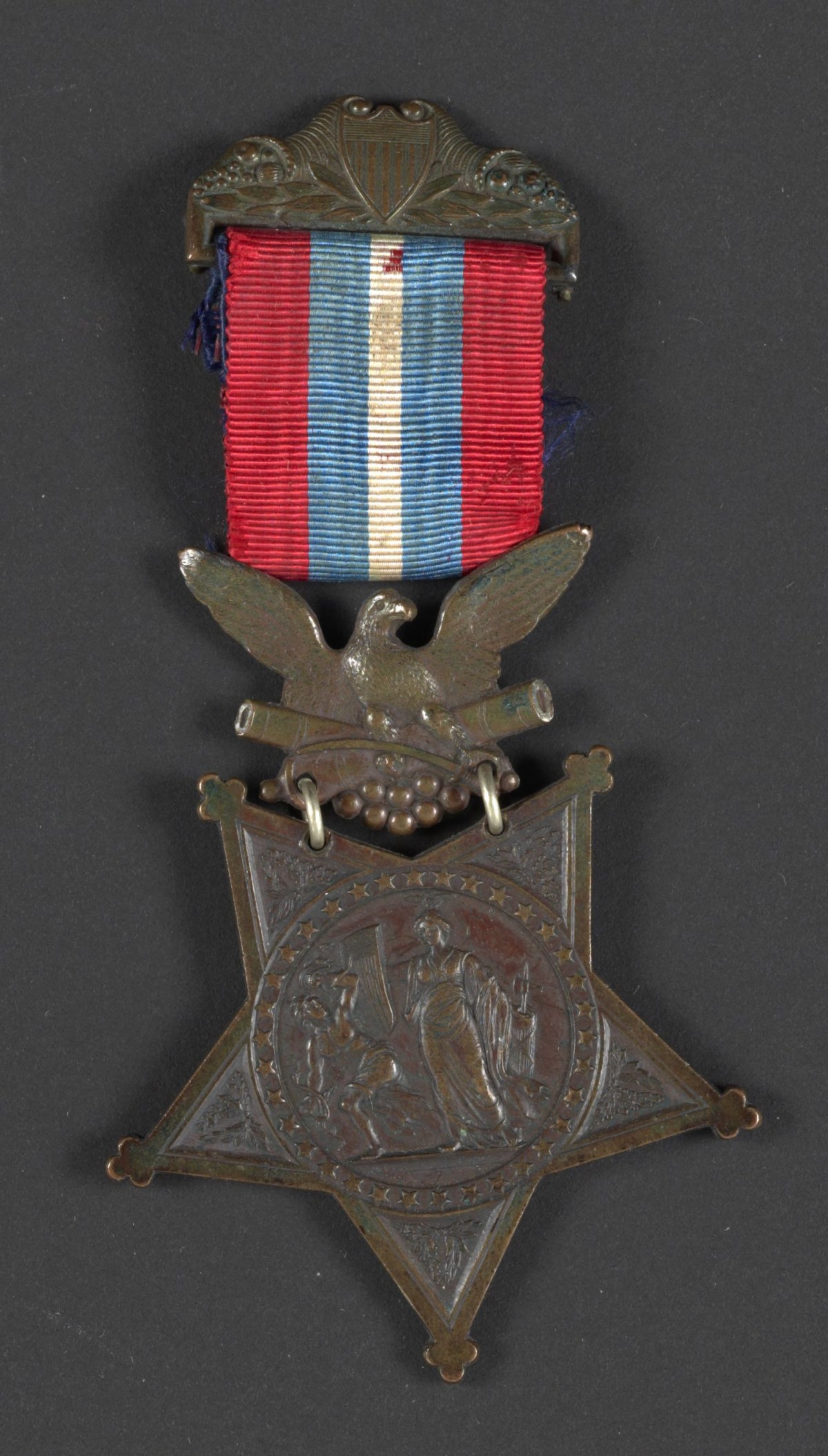
Fifty-two years later, Vernon Baker stood in the White House as President Bill Clinton placed the Medal of Honor around his neck.  What had been unknown until just a few years before his ceremony on this day, was that the United States Army had denied awarding the nation’s highest honor to Baker.  Baker knew nothing of the attempt to award him the MOH.  He retired from the Army in 1968, and had worked with the Red Cross for 20 years.  The incredibly disappointing conclusion Vernon Baker’s story is this; the Army denied Baker being awarded the MOH, not because his actions on that day in April 1945 were not heroic enough…not because he was just a lieutenant…not because Runyon tried to take credit for what he had done.  No, Baker was denied the Medal of Honor for 52 years because of the color of his skin.  You see, Vernon Baker was a black man.  

While our nation’s military has made leaps and bounds in working to eliminate discrimination, we know that there is still work to be done.  For Baker and the families of six other black soldiers (awarded posthumously), that day in the White House, was a day in which courage was shown to have no melanin limitations.

We should be reminded that God views all of us from the same lens.  Let us practice the same.    “If you really fulfill the royal law according to the Scripture, ‘You shall love your neighbor as yourself,’ you do well; but if you show partiality, you commit sin, and are convicted by the law as transgressors.”  James 2:8-9

Evil < Good

I was browsing through some stories on the internet, and after a couple of clicks, I came across the story of Helmuth Hübener.  To say that I was shocked and inspired at the same time would be an understatement.  Hübener was a German boy who found himself in a war against tyranny.  It started when he was 10, and was forced to join the Hitler Youth.  What Hübener heard everyday from those around him was that the Nazis were gloriously winning every battle, giving righteous praise to their objectives.  However, he was soon going to discover the real truth.

One day Hübener was listening to his brother’s short-wave radio.  He had to listen in secret because the Nazis prohibited anyone to listen to any news that came from an outside source.  This day he had tuned into the BBC, and he could not believe what he was hearing.  What the broadcaster was saying was completely different from what the young boy heard from friends, family and co-workers.  Apparently, Germany was not succeeding as well as they purported.

When Hübener turned 13, he quit the Hitler Youth after they played a part in Kristallnacht, a night in which Nazi sympathizers destroyed synagogues and set fire to Jewish property.  This would prove to be a sign of things to come when Hitler directed the deaths of millions of Jews in the Holocaust.  By the way, Whoopi, it was about race.

Enlightened by truth, Hübener began talking to others about what he had heard and how he felt.  He discovered that others felt the same way.  With the help of a few friends, he printed pamphlets based on information obtained from the BBC broadcasts, leaving them in phone booths and on bulletin boards.  He did this, all while knowing the risk of being discovered.  And that is exactly what happened.

A co-worker in the social administration saw him writing the pamphlets and turned him in to Nazi party officials.  He and his friends were arrested and thrown into the Plötzensee prison.  For the next ten weeks they were tortured while they waited for their trial.  Refusing to back down, he confronted the judges about the atrocities the Nazis were committing.  When the trial ended, Hübener was found guilty and sentenced to death.  His friends were sentenced to labor camps.  Hübener had the opportunity to speak before his sentencing.  Hübener told them, “I have to die now for no crime at all.  Your turn is next.”  On October 27, 1942, Hübener was beheaded.  He was 17.

As I wrote at the beginning…I was both shocked and inspired by Hübener’s story.  Shocked that a tyrannical organization would execute a 17-year old.  Yet inspired that someone so young would stand up to a very powerful force.  We often hear the expression, “The only thing necessary for the triumph of evil, is for good men to do nothing.”  Hübener chose to do something, even when it was immeasurably easier to do nothing.  

History has a unique way of repeating itself.  It may not be the 1940s, and we may not be talking about Nazi Germany today, but Europe is facing another crisis that seems eerily familiar.  Russia is on the move, crossing borders and taking land that belongs to others.  Hitler is long dead, but tyrannical leaders are not.  Putin and his ilk will always be.  Fortunately for the world, Hübeners will always be as well.  We desperately need more Hübeners…those that witness abuses, barbaric acts, violations of human dignity, savagery…and refuse to stay silent.  Let me close with this final thought.  The Apostle Paul summarized it best, when penning a letter to the church in Rome, he wrote, “Do not be overcome by evil, but overcome evil with good.”  Eleven words so aptly reflected in the life of 17-year old Helmuth Hübener.

“Read” on

In horse racing, there is the Triple Crown.  It’s made up of the Kentucky Derby, the Preakness, and the Belmont Stakes.  The Kentucky Derby is the youngest of the three races, created in 1875.  The three races were not referred to as the Triple Crown until 1930, and was not officially called it until 1950.  In the entire history of the three races,  only 13 horses have won all three races in the same year.  So obviously it’s a rare occurrence.  

In the founding history of our nation, there are two primary documents…the Declaration of Independence and the Constitution.  There are a combined 95 signatures on the two documents.  *Cue the deep voiced narrator of Law and Order…“In the history of the United States, there were two documents written by two separate but equally important groups of people; the Second Continental Congress, and the Constitutional Convention.  These are their stories. (bump bump)”  Now, because of the timing, and the organization of the separate gatherings of men, most only signed either the Declaration of Independence, or the Constitution.  However, there were six men who actually signed both…another historical rarity.  George Read was one of those men.  Teaser alert…like Secretariat and the other 12 Triple Crown winners, Read had a triple crown moment of his own.

Read was born in Maryland but his family moved to Delaware early in his life.  He studied law in Philadelphia, and perhaps, because of a couple of guys who were up to no good, and who started making trouble in the neighborhood, he moved.  Not to Bel Air, but to New Castle, Delaware.  Once settled in, he started working for the British government as an attorney general.  But in 1765, Britain imposed the Stamp Tax, and Read was not happy.  He resigned from his position and became a member of the Delaware legislature.  If you thought that because he quit his job working for the King, that he was a die hard fighter for independence from the Crown, you would be wrong.  He certainly despised the tax, but he was not for independence at that particular moment.  On July 2, 1776, when the Second Continental Congress called for a vote on independence, Read voted no.  However, the majority of the men gathered in Philadelphia wanted to break from Britain, so he went ahead and signed the Declaration of Independence.  In the end, he did so because he felt like he had to go along.  The rest is history.  The Americans won the war, and obtained their independence.  Read should have gone on to retirement; after all he was 64 years old.  But he had more work in him.  When some members felt like representation should be based on population, it was Read who argued that each state should have equal representation.  His argument won the day, and that is why we have two senators from each state no matter what the population..equal representation, thanks to George Read.

I hinted earlier at Read’s triple crown moment.  As I said, he signed the Declaration of Independence and the Constitution.  So that is two.  Where is the third?  Well, when the Constitution was being ratified, his friend and fellow Delaware delegate John Dickinson, could not be present.  So Dickinson instructed Read to sign in his place.  So if you look at the Constitution today, you will see George Read’s signature first in the Delaware grouping.  Two lines below is John Dickinson’s signature…except that it isn’t.  It’s where George Read signed John Dickinson’s name, making Read the only one to have signed three times, and hence, his triple crown moment.