
I first met him while taking a class for my undergraduate degree. To say I was fascinated with him would be an understatement of epic proportion. I was, simply speaking, captured by the many facets of his life. I could not get my fill of information about him, even to the point that I wrote my undergraduate capstone paper on him. Now I enjoy periodically going back and rereading some of the material I have on his life, and recently bought a new biography focused on his early life. So, who is he? Joshua Lawrence Chamberlain. Let me tell you a story.
Joshua Chamberlain was an extraordinary man. He graduated from both Bowdoin College and Bangor Theological Seminary, and by the time he was finished with his education, he was fluent in 10 languages. Bowdoin College hired him as a professor of rhetoric and languages, and he held the top position of department chair until he answered Abraham Lincoln’s call for troops. He joined the Union Army as a lieutenant colonel, even though the governor of Maine insisted he enter as a colonel. Chamberlain refused this because he felt he was not ready to lead men into battle. Better that he learn from the experience of others first. He was assigned to the 20th Maine Regiment who saw their first action in December 1862 during the Battle of Fredericksburg. The Confederates easily defended the heights above Fredericksburg while Chamberlain and the 20th became pinned down throughout the freezing night. When it was all over the Union Army retreated down the hill, across the Rappahannock River, and back through the streets of Fredericksburg.
Chamberlain next saw action on July 2, 1863, during the Battle of Gettysburg. By now, he was a colonel and commanded the 20th Maine Regiment. On this day, they were rushed into a tenuous position on the Union line. The defensive posturing of the Union Army looked like an inverted fishhook with the 5th Corps located on the left flank. Chamberlain, whose 20th Maine was a part of the 5th Corps, understood the consequences when he was told that because he was the end of the defensive line, he could not let Lee’s army get around him and into the Union ranks. In other words, he had to hold this position no matter what. It was at this juncture, that Chamberlain made his first brilliant decision. Knowing that the approaching Confederates greatly outnumbered his unit, he repositioned the left end of his line at a right angle facing south and east. This would hopefully deter any enemy forces approaching from the south. Chamberlain barely had his 386 men (down from nearly 1,000 when the regiment was formed in August of 1862) in position when the 15th Alabama, under the command of Colonel William Oates began their ascent up the hill, and firing into the Union lines. So began the fighting for the control of this critical position. Oates sent his men in wave after wave, only to be repelled again and again by Chamberlain and the 20th Maine. At times it looked as though the Confederates would break through the Union defenses, but each time, the men from Maine prevailed, and were able to force the men in gray back down the hill. The battle proceeded like this for more than an hour. But now the boys from Maine were very low on ammunition, and Oates’ men were reforming for another attack. What would Chamberlain do? What could he do?
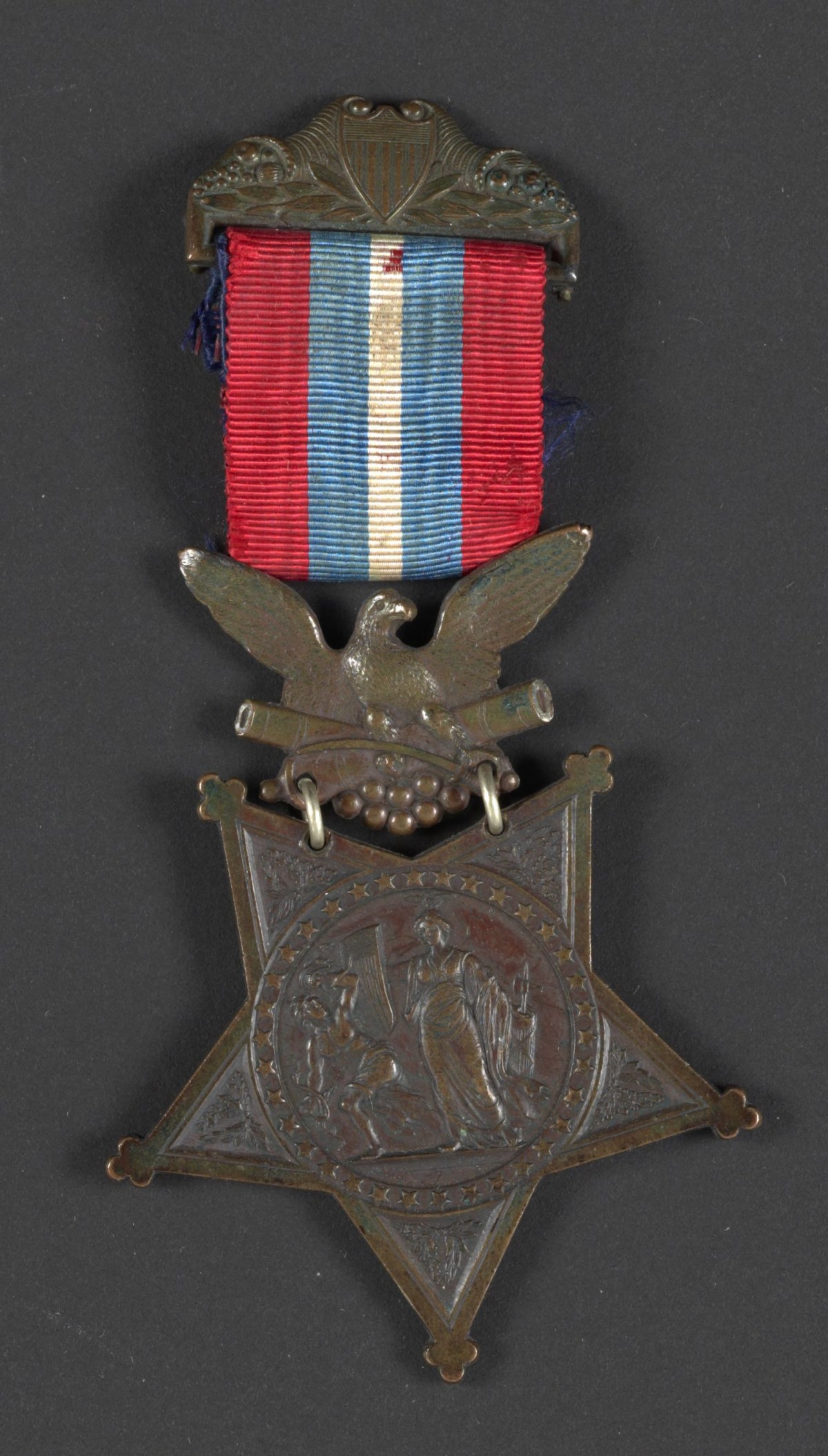
In this critical moment, Chamberlain made his second brilliant decision. He spoke one word…understood by everyone. “Bayonet”. With that one word, every man affixed his bayonet to the end of his rifle. He then ordered the men at the right angle to swing around and form a single straight line with the rest of the regiment, and at that point down the hill they charged, surprising Oates’ men. They would take several hundred prisoners during that charge, and for his part in leading the 20th Maine, Chamberlain would be awarded the Medal of Honor for, as the citation reads, “Daring heroism and great tenacity in holding his position…”. At the core of both of those words, heroism and tenacity, lies courage.
This is where it gets a little (who am I kidding) no…greatly uncomfortable, because it involves me writing about myself. So, please bear with me while I unpack this part. I don’t often talk about this specific experience in my life, but I want to describe something that happened during a deployment to Colombia, South America. I lived in the jungle for a little over two months…yep, you read that correctly…I actually lived in the jungle. Me and Rambo hanging out, barbequing wild boar that we killed on our hunt. Ok, that part is made up…Rambo wasn’t with me. But I did have barbequed wild board. That is a story for another time though. Anyway, one day, myself and three of the five guys I was deployed with, were watching a Colombian helicopter flying around. The pilot began hotdogging it and flying close to the ground…too close as we were about to find out. We watched it enter a horseshoe-shaped clearing and then heard a loud thud, and then a high-pitched piercing sound, which we would shortly realize was the engine still trying to turn the rotors which were now stuck in the ground. Knowing instantly that the helicopter crashed, I turned to the others and said, “Let’s go”. I know this sounds like something out of a movie, but this really happened, and I really said those words. We began to run across what we thought was simply an open field, but turned out to be a thick, mud-filled, boggy marsh. (We later found out that this marsh was home to leeches and poisonous snakes.) It took what seemed like an eternity to go those couple hundred yards, as each step had us sinking thigh-deep into the miry ground. When we finally got to the helicopter it was on fire, the engine was still running, and there were injured bodies all over the place. Now, one thing I failed to mention was that there were nine people on that flight…too many but the pilot didn’t care. They were all injured, some worse than others. One particular Colombian soldier had a pretty severe head injury, another had, we would later find out, several broken ribs and a punctured lung. With the fire near the side-mounted machine guns (loaded with live ammunition), we had to work fast to get everyone moved to a safe distance before that ammunition started exploding. We were also worried that the rotors would break off with pieces becoming flying projectiles. Shortly after we got everyone off the helicopter and moved to a safe distance, the two firefighters we had deployed with us, arrived, and put out the fire. I am skipping much of the details for the sake of the length of this post, but suffice it to say, it was a high-octane, high-stress moment.
Now, I share this because, like Joshua Chamberlain, I am just a normal guy. Chamberlain was a professor who in a moment of crisis, answered the call. I was a young staff sergeant who also answered the call when this other moment presented itself. But that is where the similarities end. Chamberlain was a New Englander from Maine, an officer in the army, who responded to the crisis on a hill in Pennsylvania. I was enlisted, from the Midwest, who responded to the crisis in a jungle in Colombia. We were worlds apart. But crises don’t discriminate. They don’t look at the color of our skin, our educational background, our upbringing, or anything else that differentiates us from the next person. They just happen, and we must choose how to respond.
Again, I don’t tell that story very often because it kind of feels weird to do so. By the time I returned home from Colombia, news of the event had already made its way to my leadership. As a result, I received a very high military decoration for what I did. Every time I wore my service dress uniform, people would ask about it. Sometimes I told the story, other times I did not. When I did, I wanted them to know it wasn’t just me. It was all of us. When the crash happened, I didn’t think about the consequences. I just acted. If I hadn’t been there to say those words “Let’s go”, I want to believe someone else would have, because I feel there is an intrinsic element of courage in us that is ready at a moment’s notice to jump into danger and help if needed. I cannot explain why one person responds and another looks away, or why one person lends a helping hand and another pulls out their cell phone to film it. Perhaps that courage I referred to earlier is buried too deep in some. Let me say again, there is nothing special about me. I just happened to be there, so I acted. I guess when I tell this story, it is because I want others to know that they can be courageous as well. In the end, the power is in how each responds when called…it’s that simple.
“Have I not commanded you? Be strong and courageous.” (Joshua 1:9)
 Faith, Leadership, and History